
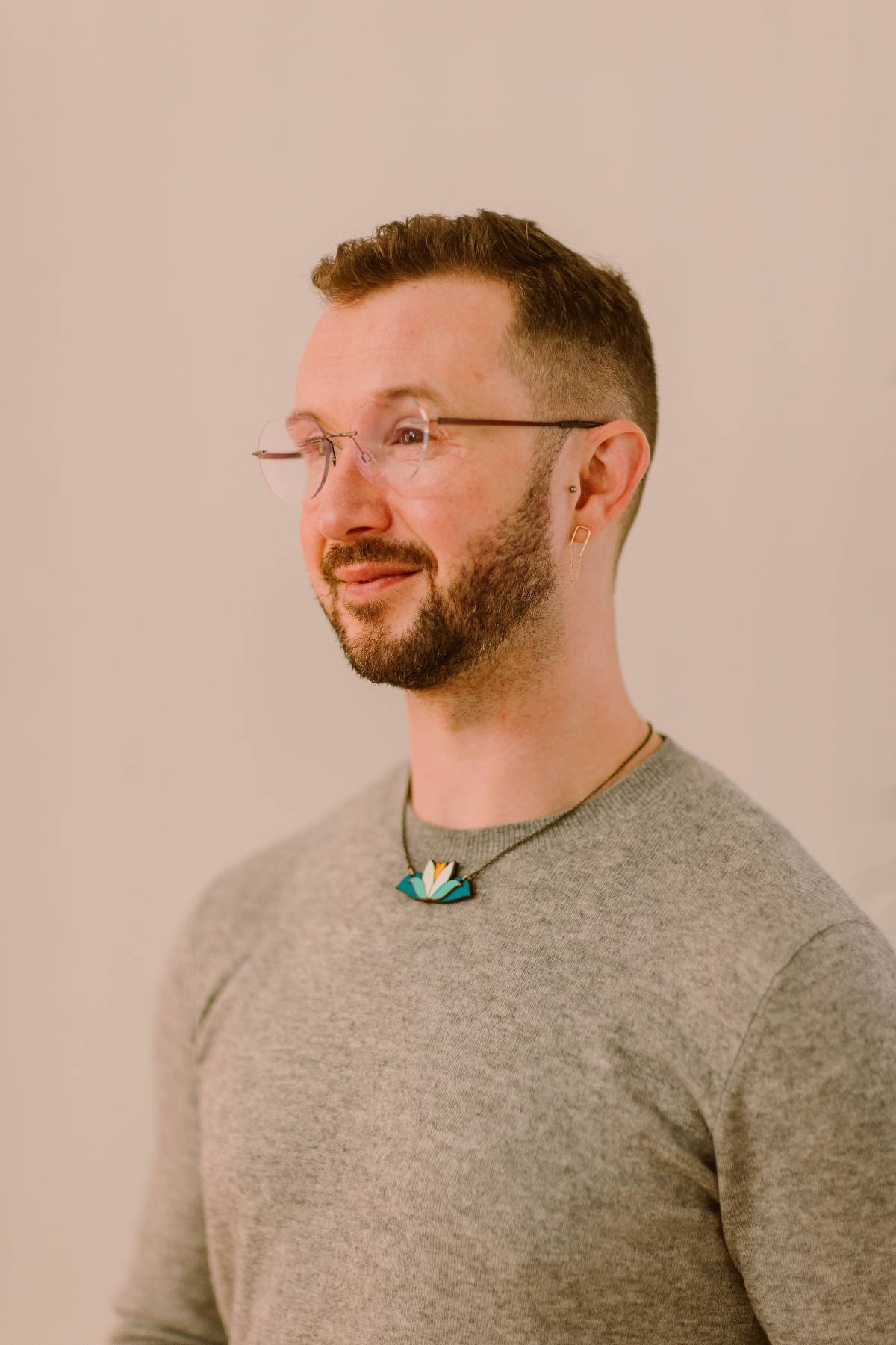
Jack begins not with certainty but with a question most people spend a lifetime avoiding: what if the very thing we were taught to hide is the key to understanding ourselves? This conversation moves beyond the surface of intimacy, positioning desire not as something to fix or filter but as something to listen to with honesty and depth. For Jack, early experiences were marked by secrecy and shame, a quiet tension between what felt true and what felt permitted, yet over time, that friction became transformative.
What once felt like something dangerous revealed itself as a signal, pointing directly toward authenticity rather than away from it.There’s emotional intelligence in the way he unpacks shame, not as an enemy, but as a learned response shaped by judgment and fear. In both his personal evolution and his work with clients, he reframes it as a doorway, one that invites curiosity instead of avoidance. His voice carries the authority of lived experience, grounded in the understanding that desire, when explored with consent and awareness, can become a powerful form of self-recognition.
It’s here that the connection between mind and body sharpens, where the stories we’ve internalised begin to either restrict or release us, and where pleasure becomes less about performance and more about alignment.
In this conversation with Jack, we step into the nuanced space between conditioning and choice, exploring how unlearning shame can open pathways to a more honest, embodied, and unapologetic relationship with desire.
Website
Early Shame Into Erotic Power
As a gay man whose first sexual experiences were soaked in secrecy and shame, what was the rawest moment you realized that the same shame could actually become the hottest fuel for authentic desire instead of something to hide from?
Jack: I think shame tends to shine a light on the things that are really true about us. When we feel shame around sex or sexual experiences, we’re often signaling to ourselves, “Oh wow, I’m actually into this… and I’m really scared I’ll be judged or rejected for it.”
In my own life and in the lives of the clients I work with, shame can become a doorway into understanding desire. If we can learn to look directly at what we feel ashamed of, whether it’s our sexual identity, a kink, or a fantasy, and explore it safely, with consent and curiosity, something shifts. We start giving ourselves permission.
And from there, we can unlock some of our core sexual desires. Shame, essentially, becomes something to lean into rather than run from. It points the way towards who we really are and what we really want.

Pathways to Authentic Queer Pleasure
You speak openly about the role of shame in shaping queer sexual experiences. From your perspective, what are some of the most powerful ways individuals can begin unlearning that shame and reclaim joy in their intimate lives?
Jack: None of us are born feeling shame. It’s a socially learned emotion. When we’re young, we try something, get judged or punished, and learn that what we did was “bad,” often internalising that as WE are bad.
So shame, at its core, is about trying to protect ourselves from judgment and rejection.
In therapy, we often distinguish between healthy and unhealthy shame. Healthy shame helps us respect important social boundaries (for example, not masturbating in public even if the idea turns you on). It keeps us out of trouble.
Unhealthy shame, though, is when that fear of judgment gets overgeneralized and applied to parts of ourselves that don’t need to be hidden, like being into some consensual exhibitionism.
The process of unlearning shame often looks like this:
- Noticing whether the shame is healthy or unhealthy.
- Recognising that unhealthy shame is learned, it reflects other people’s values, not necessarily your own.
- Finding a community who love what you love. If shame is learned socially, it can also be unlearned socially.
When you connect with people who share or accept your desires, whether that’s in kink spaces, LGBTQ+ communities, or elsewhere, your identity gets reflected back with acceptance rather than judgment. That’s where real change happens.

“Wrong” Fantasy That Was Actually Right
What’s the most “forbidden” fantasy you’ve heard from a client that actually turned out to be one of the healthiest, most liberating expressions of their authentic self and why do you think society still calls it wrong?
Jack: Ooooh, that’s a juicy one.
Without sharing specifics, I’ve worked with clients who are deeply turned on by larger-bodied people. It is central to their attraction, and they often struggle to feel desire otherwise. But because of how negatively society views larger bodies, these clients carried a lot of internalised disgust about that attraction.
In doing this work, I also have to confront my own judgments and biases, for example, my own fatphobia. I can’t support clients in working through shame if I am, even subtly, reinforcing the idea that their desire is “wrong.”
Over time, a lot of clients are able to see that there is nothing inherently wrong with their attraction. The problem wasn’t their desire — it was the cultural lens around it.
Society still labels this kind of attraction, especially ones around body size – as “wrong” because it disrupts systems that police bodies, particularly women’s bodies. If people are shamed both for having certain bodies and for desiring them, that system stays intact.

BDSM Isn’t Abuse: Here’s Why
You work kink-aware; what’s your hottest take on people who say, “I could never do BDSM because it’s abusive”? How do you flip that script in one sentence?
Jack: Sex acts aren’t inherently abusive. People are. And people can bring abusive dynamics into any kind of sex, BDSM, or otherwise.
What I see in my work is that BDSM can actually be a highly conscious space to explore power and control, dynamics that exist in every human interaction.
In fact, my kinky clients are among the most aware of issues like power, rank, and privilege, precisely because they’ve had to engage with them so explicitly in their sexual lives.

Who Still Polices Our Pleasure
How do you think queer sexual experiences are still being policed or stigmatized, and what does freedom in intimacy look like for queer people today?
Jack: UK society has become far more accepting of lesbian and gay identities over the past 20 years, but that acceptance hasn’t extended evenly, especially for bi, pan, ace, trans, and non-binary people.
We’re also seeing a resurgence of harmful narratives, particularly the idea that queer identities “corrupt” children. These ideas echo what was widespread in the 80s and early 90s, especially in how trans identities are falsely linked to harm and even child abuse. It’s deeply damaging and completely unfounded.
Then there are the subtler forms of stigma. Anal sex is still treated as taboo. Having multiple partners is framed as unhealthy or “slutty.” Non-monogamy gets labelled as being greedy or commitment-phobic. Bisexuality is dismissed as confusion (look at all the “bi now, gay later” narratives).
All of these narratives take ordinary expressions of queer sexuality and frame them as signs of dysfunction or damage.
So for me, freedom in intimacy means giving ourselves permission to pursue the sexual experiences we choose safely and consensually, without internalizing those messages that tell us we’re wrong for wanting what we want.

Turn-On You Shouldn’t Apologize For
If desire really isn’t something to fix, what’s the one “problematic” turn-on you wish more people would stop apologizing for and just fucking own so they could finally come without the guilt monologue?
Jack: I don’t think I can narrow it down to just one!
Maybe you feel uneasy about wanting to get a bit subby, or to be called names, or to explore pain play. Or maybe it’s the opposite; you’re uncomfortable being the one in control, being the dom, and wanting someone to submit to you.
You’re allowed to be turned on by what turns you on.
Kinks and fetishes aren’t inherently signs of trauma, and even if they are connected to your history, you’re still allowed to engage with them in ways that are safe and consensual.
That’s the key question: can you explore your desires while maintaining safety, communication, and ongoing, enthusiastic consent? If so, there’s nothing to apologise for.
Gap Between You and “Should Be”
If someone reading this interview feels stuck between who they are and who they think they’re supposed to be in their relationships, what is the first step toward building something more honest and intentional?
Jack: Start by noticing where what YOU want ends and where OTHER people’s expectations begin.
That gap is often where we get stuck trying to mold ourselves into something that doesn’t feel true. And the body tends to register that tension: tightness, anxiety, difficulty staying present, reduced arousal, even dissociation during sex.
Your body can be a really useful source of data here. It can tell you when you’re moving away from yourself and when you’re moving towards something that feels alive and authentic.
So the work is to get curious. What creates tension? What creates a sense of expansion, desire, or aliveness?
If you can stay open and compassionate towards those signals, they can guide you back towards something more honest and more fully yours. And that can unlock a whole treasure trove of desire and pleasure!

Editor Note
We’re so often taught to treat shame as a warning sign, something that signals danger or deviation. But what if, as Jack suggests, it’s actually a form of misdirected intelligence, pointing us toward the parts of ourselves we’ve been conditioned to deny?
There’s something deeply disarming about the idea that desire doesn’t need fixing, only understanding. That the body, when listened to without judgment, can guide us more honestly than any rulebook ever could. This isn’t about indulgence; it’s about alignment. About learning where you end, and expectation begins.
And maybe that’s the real provocation here: not that our desires are too much, but that we’ve been taught to trust them too little.
What if the truth of who you are lives exactly where you were told not to look?
