
What if everything we’ve been taught about intimacy is incomplete?
For years, intimacy has been reduced to sex, relationships have been measured by labels, and desire has been confused with performance. But Magda Kay invites us to question those narratives and explore something far more profound. Drawing from years of studying Tantra, psychology, energy work, and healing traditions across India, Nepal, Thailand, Malaysia, and Bali, her work reframes intimacy as a lifelong relationship with ourselves, others, and the world around us.
Magda explores why so many people mistake sex for connection, what “faking it” truly reveals about emotional conditioning, why desire naturally fades without intention, and how genuine sexual empowerment begins not with saying yes, but with confidently saying no. She also challenges long-held cultural myths about masculinity, femininity, pleasure, and relationships, offering a perspective that is both compassionate and refreshingly honest.
This is more than a conversation about sex. It is an invitation to rethink connection, embrace authentic desire, and discover why intimacy may be one of the most important human experiences we will ever learn to cultivate.

Intimacy Stopped Being About Sex
You’ve studied Tantra, psychology, energy work, and healing traditions across India, Nepal, Thailand, Malaysia, and Bali. Looking back, was there a defining moment when you realised intimacy wasn’t simply about sex but about the way we relate to ourselves and others?
Magda: Once I dived into the world of tantra, I expanded my understanding of sexuality in many ways, and one of them was exactly this: understanding that intimacy is not the same as sex, that it’s so much more. And I think the fact that we equate intimacy with sex is at the root of a lot of people feeling lonely in life. So intimacy is actually one of our foundational needs, and we have studies that show that we actually need intimacy to survive. We have studies that show we will choose intimacy, cosiness, and contact over food. So we all need it, but we are told the story that intimacy comes through sex, which naturally means that the only way for you to have that feeling of intimacy in life is by engaging in sex with someone. So what happens when you believe it? We often rush into sex when we are not ready, or with someone we may not necessarily want to have sex with, because we’re longing for intimacy. At the same time, this narrative means that unless you’re having sex, you will not have intimacy in your life. It leaves single or celibate people stuck, convinced there is nothing they can do to experience intimacy. And it’s just not true. One of the big messages in my work is to really help expand people’s understanding of what intimacy is and separate it from sex or, in fact, de-sexualise intimacy.
For me, intimacy is about the depth of connection – and connection is the key. Intimacy always lives in relation to something or someone. So absolutely, yes! You can have intimacy when having sex with someone. But you can experience intimacy in any situation when you are relating to something else. I talk about three pillars of intimacy:
- The first one is the intimacy that you experience in relationships with other people
- The second one is the intimacy you experience in the relationship with yourself.
- The last pillar is the intimacy you experience with life itself. This can be perceived as intimacy with nature, intimacy with God, or intimacy with consciousness.
Notice sex is none of the three pillars – it is a part of the first pillar, meaning the relationships with other people. And this is not just about romantic or sexual relationships; it is about all relationships with other people. So really, sex is just a small part of how we can seek intimacy in our lives.
It also doesn’t mean that when you are not having sex, you are automatically experiencing intimacy. These two are separate. Of course, when sex and intimacy overlap, you have the best experiences, but I think many of us have experienced sex that lacked intimacy, and it just didn’t feel very deep.
I’m a big advocate for meeting our need for intimacy through all three pillars. That makes us better partners and better lovers. When we do engage in sex, we can bring our ability to connect on a deeper level.

We’re Really Saying When We “Fake It”
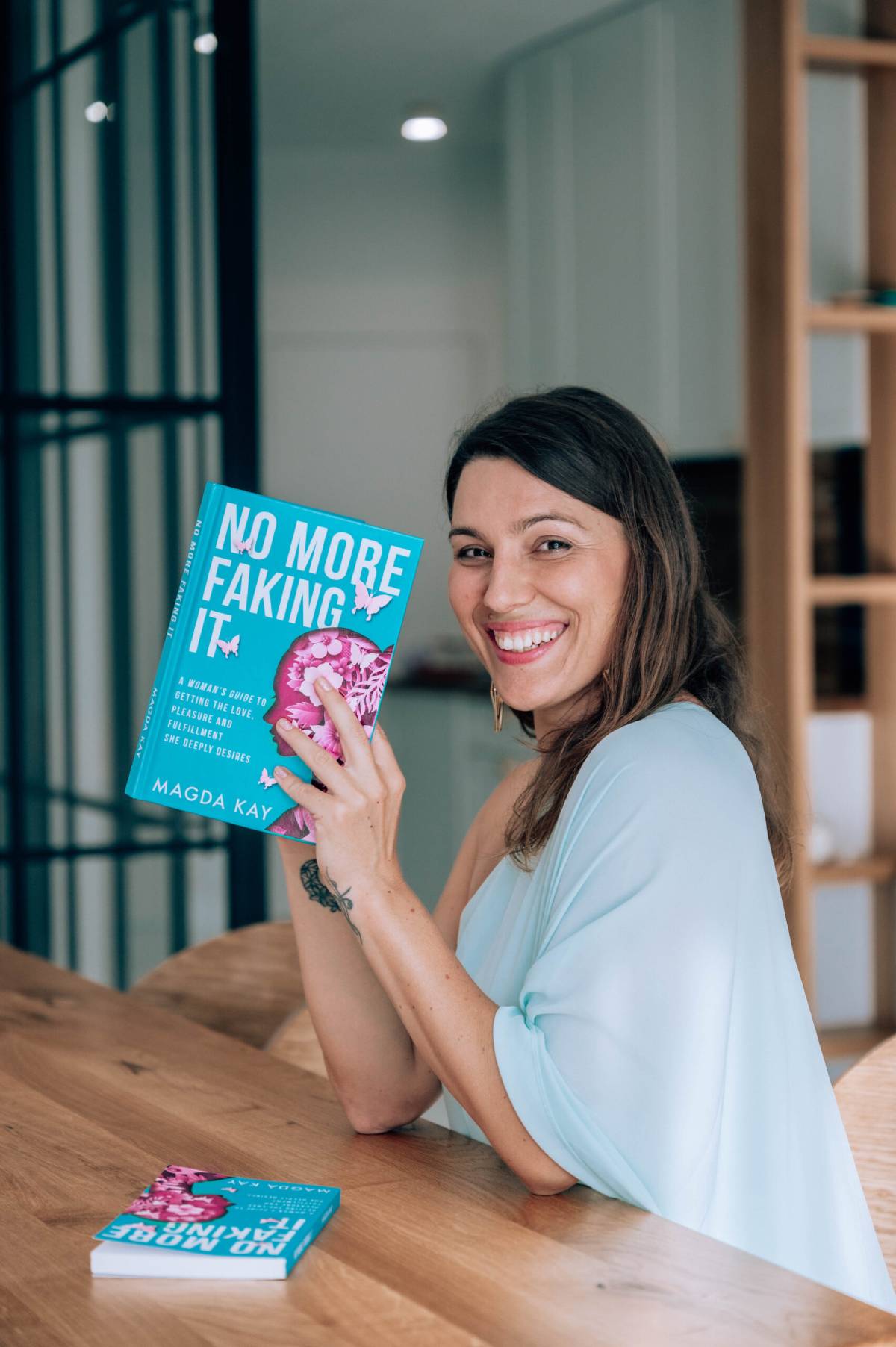
Book No More Faking It speaks directly to women seeking deeper love and fulfilment. Beyond physical pleasure, what does “faking it” represent emotionally, and why do so many people continue performing instead of expressing what they truly desire?
Magda: I picked this title on purpose. Of course, seeing “No More Faking It, we assume it’s about faking an orgasm, but this is actually so much bigger.
As women, we are masters of people-pleasing. For so long in the history of humankind, women have been the ones who had to do what other people told them. We’ve become experts at pleasing and taking care of everyone else. And so we have developed the skill to adjust, and so often we smile when we are actually angry or sad. We endure things without saying how we really feel because we don’t want to rock the boat. Women fake it all the time in every area of life.
Just think about yourself. How often have you pretended that everything was fine when it wasn’t? How many women try to protect the father who is maybe drinking, or is aggressive, or is never home, or is cheating, and yet the wife will try to protect his image in the eyes of the children? How many times at work were you not appreciated for the work that you did, and yet you still didn’t say anything? And how many times have you had sex that didn’t feel amazing, and yet you told him that it was great? How many times did you pretend to have an orgasm when you didn’t? How many times did you want to ask for something, but you simply didn’t because you didn’t want to upset him?
I am a woman myself, so I am just as conditioned. And I’m aware that this is not something that is going to happen fast. We are talking about changing generations of conditioning. But this is exactly what we should be doing: talking about it and bringing awareness to these tendencies.
The Lies We Still Believe About
If you could erase one cultural myth about women and one about men in the bedroom, what would they be?
Magda: Here’s what I see happening. For so long, women have not had the same rights as men. We have not been valued the same way as men. Naturally, for a while now, women have been raising their voices, demanding equal treatment. But because we do live in a world that is run by men and is based on patriarchal structures, the natural conclusion has been that if women should be treated the same way as men, it’s because women are like men.
But it’s just not true. I know these days it’s not a popular opinion, but the reality is that men and women are very different. On a biological level, our bodies look different, and our hormones are different, which impacts everything in our lives. Our brains are different.
Way too often, women are treated as men. Or more specifically, we are treated as little men or bad men, because if I am supposed to be a man, of course, I’m going to fail (because I’m not a man). And then we are judged by the lens of “How good a man are you?” Because I am smaller and have less muscle mass on average than a man, I’m considered to be weak. Because I am way more emotional than an average man, I’m considered too emotional. We are judged based on male qualities and inevitably, we come short.
For a moment, imagine if the world were a matriarchal place and the default model was that you focus on relationships, you are emotional, you move in cycles, and you change your mind. If you were to judge men by those measures, then you would think, “What is wrong with men?”
I think what we’re lacking is the understanding that all humans should be treated equally, with the same respect and valued the same way, not because they are the same, but simply because we are all human. I’m still waiting for the time when women’s unique talents and qualities will be valued equally to men’s unique talents. Because right now, most of the things that women are valued for are male qualities.
And of course, this shows massively in the bedroom. So anywhere where a woman is different than a man, we are judged. For example, while we do talk about foreplay, what
men consider foreplay is not foreplay for women. It hardly ever lasts long enough. And you have no idea how many times I’ve heard men say, “Who has time for this?”
The way we understand arousal, foreplay, orgasm, and just sex itself is defined through a male experience.
I believe we have to understand that men and women are different and that we both should be valued and respected, even though we’re not the same. Only then,, I think, can we actually start having great sex. The fact that a woman needs something different in the bedroom than men shouldn’t be considered something bad.
But unfortunately, I see a lot of women who are unaware of their body’s actual needs, not fully connected to their body and their sexual needs and boundaries, and in some way convinced that what they want is exactly what men want. This is just the culture conditioning. So that myth that men and women are the same is something, unfortunately, still deeply ingrained in both men and women. But I see so many coaches and online content these days that are showing these differences, and so I’m optimistic that both men and women are awakening to the fact that women are very different, and this is our unique, invaluable way of contribution.

Tension That Keeps Love Alive
Healthy relationships require both emotional safety and erotic energy, yet many couples feel they lose one while trying to protect the other. How can partners maintain passion without sacrificing trust, comfort, or authenticity?
Magda: Love and desire are what we call opposite needs. That means that the things that build one destroy the other. Love thrives in familiarity, closeness, predictability, and safety, but desire, or eroticism, thrives in the unknown, danger, excitement, and newness.
You can think of these two needs as a scale. On one end, you have love, and on the other, you have desire, and you simply slide along that scale.
The thing is that with these opposite needs, there is no one perfect point on the scale. Instead, we have to be reacting to what is happening in our lives. So there will be moments when we may want to focus more on love and other times when we want to focus more on desire.
Because of how we structure relationships in modern times, naturally, after being together for a longer period, we start sliding towards love. We move in with each other; we start sharing more activities together; we sleep next to each other in the same bed. So as the relationship progresses, so does the familiarity, safety, and closeness. And because of the lack of awareness that desire is the opposite of love, unless we Consciously do something to slide on that scale the other way, and we will start moving closer and closer towards love and further and further away from desire.
So what couples need to be doing is to try to slide towards desire. And because life naturally pushes us towards love, it will take some effort to do it.
And this is important. Many couples are disappointed that after a few years, there’s no more passion. When you suggest things like scheduling sex, they’re very resistant to it because they want desire to be spontaneous, to be automatic, the way it used to be at the beginning of the relationship. But the reality is that it just doesn’t work like this. Because remember, you are now in a relationship – and that is designed to create more familiarity and closeness. In order to move towards desire, you actually have to put in some effort. This can look like scheduling sex or having weekly dates with your partner and taking care of your looks (because the truth is that we usually let ourselves go once we are in a relationship), so this is about hitting the gym, looking your best, and still taking care of your physical appearance, which does impact our sexual desire for each other. This can be reading books and watching YouTube videos about sex, signing up for courses about sexuality, expressing sexual fantasies, and talking about them (and seeing if there is something that you may want to experiment with). There are so many sexual things that you can try, whether this is attending a sex party, watching porn together, or visiting a sex shop.
And some of these things may feel scary because they’re outside of your comfort zone, but that’s one of the ways to move closer to desire – trying something new!

Everything We Don’t Say Out Loud
Do you think we’ve become too obsessed with labelling every relationship dynamic, kink, or attachment style instead of simply learning how to communicate honestly?
Magda: I personally really like labels and systems because they help us understand what’s happening. Unless you can name something, unless there is a language to describe it, the concept doesn’t actually exist. This is why the advancement of relationship psychology is so helpful for all of us to actually make our relationships better. It has explained certain things that maybe you felt, but because you were not able to name them, you may have dismissed them. It has given us vocabulary and concepts to actually have these deep conversations. I personally think that it’s very useful, and I am a big proponent of everyone actually educating themselves about attachment styles, different forms of relationships that go beyond a traditional monogamous concept, or different kinks.
However, I do believe that labels are a double-edged sword because while they help us understand ourselves and express ourselves, we can become too attached to them. And
Still, all the labels and concepts are limited, and so sometimes we may end up forcing ourselves into a certain label even though we don’t really fit.
So that idea of identifying yourself with a label is actually very dangerous, but it is very common for humans because that’s just how our psyche works. It needs to understand: who am I and how do I fit in the world? So to me, yes, I love them, and I find them useful, but it’s a fine line to navigate, and we have to be mindful not to over-identify with them.

If every reader of The Sin Edit
Could leave this conversation with one belief about sex, relationships, or themselves that would transform the way they love; what would you hope that belief would be?
Magda: That sex is a deep, intimate, and spiritual experience. This is what sex should be. Unfortunately, in our times, sex is either labelled something sinful and wrong or, on the other hand, it’s treated very lightly as if it weren’t a big deal.
We have these two extremes: You either don’t talk about sex, or you are suppressed, or on the other extreme, we have what we see in porn – treating sex as if it were nothing special.
But none of these things are actually healthy because, in my opinion, that’s not what sex is about. It’s not sinful. There’s nothing wrong with it. We all do it, and if we didn’t, we would not live. And yes, it’s fun, and it’s pleasant. But at the same time, it’s not something that should be taken lightly because it’s the most intimate experience you can have with another human being. And this is especially true for women. You literally invite someone inside your body. You’re mindful of what you eat or drink – we need the same filter for who we decide to have sex with. To me, sex should always be about the deep merger of two beings, and so you have to think of who you want to merge with.
I like to talk about sexual empowerment versus sexual liberation. Sexual liberation is about being able to say yes to sex. And this is how many people try to deal with sexual suppression. Sexual liberation is about the ability to say yes. But sexual empowerment is about the ability to say no. So this is about being able to recognise your own boundaries and your needs, and when it really feels like a yes, you say yes. But you can also say no. And I find that when people go too much into sexual liberation, they’re not actually empowered because they start saying yes to sex too often, confusing expressing sexual boundaries with sexual suppression.
So I would love for people to see sex as something deep, sacred, beautiful, intimate, conscious, and spiritual. Not something sinful or shameful. And to engage in it consciously, where the whole body says YES.

Editor Note
Magda Kay is one of those rare moments. One of the strongest insights from our discussion is that intimacy has never been confined to the bedroom. It lives in honesty, boundaries, emotional presence, self-awareness, and the courage to connect with ourselves before expecting someone else to complete us.
Her perspective reminds us that desire is not something we stumble upon but something we intentionally nurture, and that true empowerment begins not with the freedom to say “yes” but with the confidence to say “no”.
The deepest intimacy doesn’t begin when two bodies meet. It begins the moment we stop performing and start showing up as our most honest selves.
