
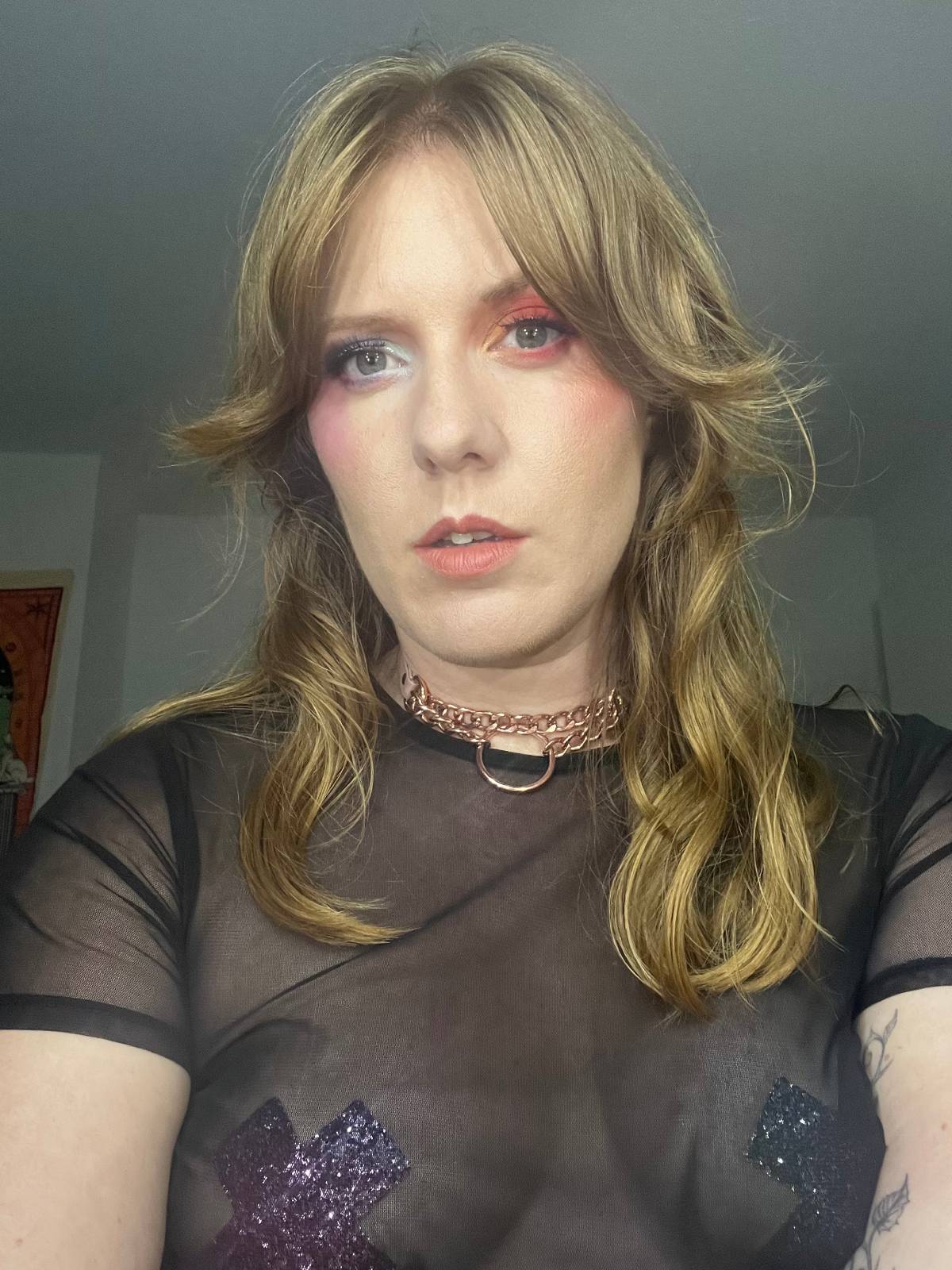
Alisa Millard, famously known as “The Shame Slayer,” shares an intimate look at how shame shaped her sexual and emotional life and how she learned to meet it rather than avoid it. From early conditioning by society, culture, and family, shame quietly dictated her needs, creating patterns of perfectionism, self-silencing, and fear in relationships. Alisa describes how recognizing these patterns, mapping her nervous system responses, and practicing self-compassion allowed her to reclaim intimacy on her own terms.
In her work, Alisa guides clients to use their bodies as an “intimacy compass,” distinguishing authentic desire from a grounded, embodied “fuck yes” from obligation or performance. Through kink, tantra, somatic practices, and queer liberation, she demonstrates how exploring boundaries, fantasies, and power dynamics can deepen self-awareness, emotional regulation, and personal growth. Vulnerability, surrender, and consent are not weaknesses but tools for connection, healing, and empowerment.
She highlights the parts of intimacy that are often over-romanticized, like effortless passion, and the elements that are overlooked, such as repair, conflict resolution, and ongoing care for emotional connection.
In this conversation, we explore her journey of facing shame, reclaiming desire, and embracing vulnerability. Alisa shares reflections on self-trust, emotional honesty, and the transformative power of embodiment, offering a candid look at how curiosity, presence, and courage can reshape intimacy, pleasure, and connection in both life and love.

Website
The Moment Shame Lost Its Power
You’re known as “The Shame Slayer,” a title that speaks directly to the hidden weight many people carry around sex and desire. Can you share a personal moment when you recognized how deeply shame was shaping your own intimacy, and what began to shift when you chose to meet it instead of avoiding it?
Alisa Millard: It’s hard to pinpoint a single moment because shame takes root so early in our lives, especially in each of our personal intimacy and pleasure gardens. And we didn’t plant those shame weeds ourselves. We didn’t get a choice. They were placed there by society, culture, religion, and family systems, by messages from the medical industry, the media, and rigid ideas of “morality.”
So while there isn’t one defining moment, there are patterns that stand out. One of the clearest places I saw shame shaping my intimacy was in how I hid my needs (sexual, relational, and emotional), especially at the beginning of my relationship with my fiancé. I would shut down when I wanted to advocate for myself. When I made mistakes, I felt deep shame and tried to hide them or soften the truth in the name of being perfect.
For me, perfection felt like the requirement for love & intimacy. I believed I didn’t get to make mistakes and that my needs mattered less than others’. That belief showed up somatically. I began to recognize that I was going into hypoarousal, specifically a freeze response, through the lens of polyvagal theory. My brain would go quiet. My body would shut down. I’d lose access to language and sensation, and then, at a certain point, that freeze would flip into extreme fawning.
Suddenly, the focus became fixing things, tending to the other person, or taking on their emotional experience instead of staying connected to my own body. It felt safer to leave me than to risk being fully present with my needs.
This pattern played out throughout the first year of our relationship. It wasn’t about my partner; it was about the wounds I brought with me, shaped by shame and intertwined with attachment wounds. Each time the pattern surfaced, I chose to meet it rather than avoid it.
The first step was mapping it. I had to learn how my nervous system moved from freeze into fawning so I could recognize it in real time. From there, I began experimenting with tools to interrupt the loop. Early on, that looked like noticing when I was fawning and asking for space (leaving the room, pausing the conversation) so I could process my emotions and return, able to speak from a more rooted place. Over time, I developed a more nuanced awareness of what my body needed: when I truly needed space and when I could re-anchor in the moment and stay present.
I also learned, through exposure, that every time I advocated for myself and my needs, without sugarcoating, it became less activating the next time. I wasn’t forcing myself through fear or shame; I was letting them be present while still choosing myself. I was rewiring my nervous system by working with those responses instead of trying to override them.
That’s where shadow work became essential. I don’t see shadow parts as something to fix or eliminate. I see them as wounded parts of us from our past. Parts shaped by earlier experiences. They color how we interpret present moments when something feels familiar or emotionally charged. When I stopped vilifying those parts and began meeting them with care, curiosity, and compassion, real integration became possible.
And that’s what ultimately created lasting change. My behavior shifted not because I pressured myself to be different, but because I was coming from intimacy first with myself and then with my partner.

How the Body Guides a True ‘Fuck Yes’
In your coaching, you beautifully intersect kink, tantra, somatic practices, and queer liberation. How do you guide clients to use their bodies as an “intimacy compass” to distinguish a true, grounded “fuck yes” from obligation or performance?
Alisa Millard: This is such a powerful question. Our bodies have always spoken to us. They tell us what kinds of feelings and experiences we want when we move toward sex or intimacy. They signal when a boundary has been crossed and whether we want to move toward something with awe and curiosity or away from something that could cause harm.
At the same time, the modern world, especially Western culture, has taught us to become removed from our bodies. We’re conditioned to prioritize logic, productivity, and cognition over body-based knowing. I name that context because my work is fundamentally about guiding clients back into their bodies so they can reclaim true sovereignty.
Using the body as an intimacy compass begins with re-establishing a somatic relationship with the nervous system. Most people have lost touch with how to read their body’s cues, and that’s not a personal failure; it’s a learned disconnection. So we start by gently reintroducing that relationship. At first, it can feel unfamiliar or even silly, because the mind wants to understand what’s happening rather than simply experience it. We’re taught to intellectualize instead of feel.
So I slow things down and help clients learn what “feeling into” something actually means. It starts with noticing sensations in real time. We track what’s happening in the body as emotions arise. That might look like noticing tingles or constriction where the breath is moving or getting stuck, shifts in temperature, impulses to make sound, or even the appearance of color or imagery. We map these sensations as they show up alongside specific emotional responses during our sessions. Rebuilding this body connection is the first critical step.
Many people are used to deciding yes or no based on thoughts, expectations, or shame (what they think they should want or agree to) rather than what their body is communicating. As clients learn to map their unique sensation patterns to emotional states, they begin to recognize what a true, grounded “fuck yes” feels like in their body versus a quiet “no,” a collapse, or a performance.
For me personally, and this won’t be the same for everyone, a true fuck yes often feels like an opening and gentle tingling in my pelvic floor, with a sense of openness where I can feel my breath travel all the way down into my hips. But what matters most isn’t my cue; it’s helping each person discover their own.
Often, someone will say, “I don’t mind doing this,” or “I think I should be okay with it,” while their body is clearly signaling resistance or distress. Learning to trust those signals allows people to anchor into their own internal cues and navigate intimacy and life from the inside out, rather than orienting around external expectations or how they believe they should respond in certain environments.
That’s when the body becomes an intimacy compass. Our bodies are not something to override but something to follow.

The Kink Society Misunderstands
Society often labels certain kinks as “too extreme” or “dangerous.” Which kink do you think is most unfairly demonized, and why do you believe it actually holds transformative potential when practiced with intention and consent?
Alisa Millard: This is a poignant question, and I want to answer it through two lenses. One is a kink that I believe is most unfairly demonized. The other is how BDSM and particularly intense forms of play are often misrepresented in media in ways that create harm and misunderstanding.
In my view, consensual non-consent, or CNC, is one of the most unfairly demonized forms of kink. It carries a great deal of complexity, and because of that complexity, it’s often misunderstood, both outside of the BDSM community and, at times, even within it. The sensitivity of the topic can lead to avoidance rather than education, which only deepens stigma.
CNC is powerful because it allows people to intentionally engage with themes like control, surrender, fear, and agency in ways that aren’t easily accessible in other contexts. For some people, it can offer a form of repetition with choice. Choice where scenarios that echo past emotional or bodily experiences are entered into consensually, with clear boundaries and the ability to stop at any time. This can allow someone to reclaim agency, rewrite how an experience lives in their body, and relate to intensity from a place of empowerment rather than helplessness.
That said, it’s important to name a common misconception: not everyone who engages in CNC has a trauma history. While CNC can be meaningful for people who are healing or working with past wounds, it can also meet entirely different emotional or erotic needs. Needs that may not be easily accessed through other types of play. At its core, CNC can be a way of exploring power, surrender, desire, and trust in a deeply intentional and negotiated way.
CNC is a form of erotic roleplay, highly potent when practiced with care, in which participants consensually agree to pretend that consent is being removed, while actual consent remains central, explicit, and ongoing. According to Justin Lehmiller, Ph.D., author of Tell Me What You Want, two-thirds of women and roughly half of men surveyed reported having forced-sex fantasies of various kinds. So while CNC fantasies may be edgy in content, they are far more common than many people realize.
Another misconception is that CNC always involves extreme sadomasochism or sexual torture. In reality, CNC exists on a wide spectrum. Fantasies can range from mild reluctance and resistance to more intense scenarios, and no single version applies to everyone. Like all kinks, it’s highly individual and shaped by the feelings someone wants to experience, not just the acts themselves.

People may be drawn to CNC for many reasons: fantasy fulfillment, exploring power dynamics, stepping into dominant or submissive archetypes, or relinquishing control in a way that feels contained and intentional. For some, CNC can also challenge social and gender conditioning. For example, people socialized to believe they shouldn’t desire sex or pleasure may find relief in a fantasy where desire is expressed without the perceived “responsibility” of initiating, thus allowing pleasure without shame. Paradoxically, that experience can be deeply empowering.
CNC can also offer profound experiences of being wanted and desired. Experiences where pursuit feels overwhelming in a consensual, negotiated way and can tap into primal dynamics. For me personally, adding an element of uncertainty or fear heightens my embodiment and presence. It brings me fully into my body and allows me to receive in ways that were difficult earlier in life, when I was conditioned to focus on others’ needs instead of my own. Within a CNC container, that sense of being chosen, pursued, and even worshipped can become incredibly healing.
Beyond erotic charge, CNC can support emotional release, nervous system regulation, and even altered states like subspace or topspace, where participants experience a deep loss of self-consciousness and a heightened sense of connection. When held within a container of trust, intention, negotiation, and aftercare, these states can feel restorative, grounding, and profoundly intimate.
I think it’s crucial to emphasize that CNC is rooted in mutual trust, clear communication, and negotiated boundaries. The issue is that we don’t have enough nuanced, public conversations about it. There’s often an assumption that CNC looks one particular way, when in reality it’s as diverse and complex as the people who practice it.
This brings me to the second lens: media portrayal. Unfortunately, mainstream representations (like Fifty Shades of Grey or Secretary) often show intense dynamics without depicting the essential foundations of consent, negotiation, and mutual understanding. They imply that a dominant partner instinctively knows what a submissive wants, that boundaries don’t need to be discussed, and that intensity simply unfolds without preparation. That narrative is not only inaccurate but also dangerous.
What’s missing is the truth: that these dynamics, when practiced ethically, are built on deep listening, explicit consent, shared intention, and ongoing communication. Changing the narrative means making space for more honest, informed conversations about desire. Conversations where we ask why someone wants what they want and how to explore those desires safely, consensually, and with care for everyone involved.

What People Get Wrong About Intimacy
Is there a part of intimacy you think people over-romanticize and another they completely overlook? Invites opinion without needing shock for shock’s sake.?
Alisa Millard: This is such a fun question because it’s something I’ve talked about a lot with my fiancé.
What I think we over-romanticize is the idea that once you find the “right” person, or people, depending on your relationship structure, things should just become easy. That you won’t really fight. That sex will always be spontaneous. That intimacy will somehow run on autopilot. There’s this fairy-tale narrative, fed to us by movies, media, family, and culture, that once you’ve done the work to find your person or people, the hard part is over.
We see this especially in romantic storytelling: the chase, the courtship, and the dramatic coming together. And don’t get me wrong, that front end of a relationship matters. Planting the seed in the right soil is important. But we put so much emphasis on the beginning that we almost completely ignore what it takes to continue and evolve a relationship over time.
A lot of people genuinely believe that sex and intimacy should just keep happening effortlessly, and that if they don’t, something must be wrong. I often use the metaphor of a plant. Early on, we water it, give it sunlight, and tend to it carefully, and we see those first blooms. But over time, we start taking the plant for granted. Life gets stressful. We forget to water it. Resentment builds. Wounds show up. We stop giving it nutrients or attention, sometimes without even realizing it.
Then one day, we look back and wonder why the plant is wilting or why the relationship doesn’t feel alive anymore. And instead of tending to the roots, we often reach for quick fixes, or worse, we blame the plant for not thriving. This isn’t about shame. It’s about the fact that we were never taught how to care for intimacy after the initial bloom.
Which brings me to the part of intimacy that I think is completely overlooked: repair. Conflict is inherent to intimacy. The deeper the emotional, physical, and soulful closeness, the more likely conflict becomes, not because something is wrong but because you’re truly known. You’re seeing each other’s habits, patterns, wounds, and nervous system responses. Humans trigger each other, even when they love each other deeply.
What we don’t talk about enough is how to work with that conflict in a way that actually deepens intimacy. From rupture comes repair, and from repair can come a stronger, more resilient bond, but only if we have the tools. Most of us don’t. We show up to conflict through our old attachment wounds and protective strategies: attacking, withdrawing, people-pleasing, avoiding, or urgently trying to fix things so we don’t lose connections.
Even when we logically know better, our nervous systems are trying to protect us from pain. Those protective parts come online fast. And unless we learn to recognize them, work with them, and take responsibility for how they show up, we end up repeating the same patterns. Sometimes, avoiding hard conversations altogether only builds resentment over time.
We aren’t taught skills like empathetic listening, accountable repair, or how to have conflict without shame and blame. We’re taught a false narrative: that intimacy should be effortless if it’s “right.” In reality, intimacy is vulnerable. It’s confronting. It asks us to unlearn old programming and build new relational muscles over time.
Just like going to the gym, this isn’t a one-conversation fix. It takes repetition, patience, and a lot of grace. Our bodies are wired to return to what once kept us safe, even if it no longer serves us. So the work is slow, relational, and ongoing, but when done with care, it’s what allows intimacy to stay alive rather than slowly wither.

Lessons for Non-Monogamous Love
Jealousy is often treated as the ultimate enemy in non-monogamous relationships. Do you think jealousy ever has a positive role to play, and if so, how can people lean into it as a teacher rather than something to suppress?
Alisa Millard: Jealousy is one of the most weaponized emotions I see, especially in polyamorous or ethically non-monogamous relationships. It’s deeply misunderstood. As a culture, we like to label emotions as “good” or “bad,” but that framing doesn’t actually serve us. Emotions are information. They exist to share data about what we’re experiencing.
The only emotion I believe truly has no place in our world is shame, but that’s a different conversation. Outside of shame, every emotion has a function, including jealousy.
From a young age, we’re taught that jealousy is wrong or selfish: don’t envy others, don’t covet, and don’t want what isn’t yours. At the same time, jealousy is quietly baked into how we’re taught to understand relationships, especially monogamous ones. Because we’re conditioned to believe that deep intimacy should only ever be shared with one “soulmate,” jealousy often gets framed as proof of love. That’s how control, possessiveness, and territorial behavior get justified in the name of romance.
When someone else receives attention, affection, or desire from a partner, it can trigger the fear that there will be less left for us, that we’re replaceable, or that we’ll be left behind. Jealousy can take many forms, but instead of understanding it as emotional data we can work with, we’re taught to suppress it or judge it.
This becomes especially harmful in poly or ENM spaces, where jealousy is often used as a litmus test: If you feel jealous, it must mean you can’t do non-monogamy and should go back to monogamy. That’s simply not true. Jealousy shows up in monogamous relationships all the time as well; it just gets expressed differently, often in ways people aren’t proud of.
Because jealousy is so stigmatized, we first have to stop treating it as a moral failure and start relating to it as information. That begins with learning how to feel it in the body. What does jealousy actually feel like when it arises? Once we can track the sensation, we can notice the behavioral impulses that come with it: do we want to fight, freeze, lash out, dissociate, demand reassurance, or shut down?
From there, the work becomes about shifting our response rather than suppressing the emotion. That can look like sitting with jealousy for a moment and getting curious. Are there memories attached to it? What does your body think might happen? What is it trying to protect you from? What support does it need?
Approaching jealousy with curiosity instead of judgment helps reroute the shame that often gets layered on top of it. And when we do that, a narrative usually starts to emerge.
For example, I’m feeling jealous because my partner is going on a date with someone attractive, and underneath that is a fear that I won’t be enough, that they’ll love someone else more, and I’ll be left behind.
These narratives are incredibly common and deeply human. When we meet them with curiosity rather than fury, we create space for compassion both for ourselves and for the emotion itself.
Only after that internal work do I encourage people to bring jealousy into relationship dialogue if the context involves a partner. That conversation works best when it’s grounded in “I feel” statements rather than blame and when it’s clear what support is being asked for, whether that’s being listened to, held, reassured, or collaboratively problem-solving.
When jealousy is worked with this way, it stops feeling like a monster. He becomes a teacher. And while this doesn’t change overnight, each time someone treats jealousy as information instead of something to suppress, they begin to change how that story lives in their body and how they show up in their relationships.

The Changing Landscape of Desire
Has your definition of “good sex” changed as you’ve grown older or more embodied? If so, how?
Alisa Millard: Yes, 100%. It has absolutely changed. I wouldn’t call it a 180-degree shift because that feels a bit cliché; it’s been more of an evolution. Earlier versions of me had what I would call decent sex, but it wasn’t nearly as emotionally satisfying as the way I experience sex and kink now.
Through my own personal evolution, and through the work I do with clients, I’ve come to understand that good sex is far more rooted in the emotional experience someone wants to have, the level of intimacy that’s present, and the capacity to be fully engaged in what’s happening. And that engagement can look different for different people; even running a fantasy internally during sex can be part of that presence.
Good sex is much less about technique or the toys being used. Those things matter, and they can absolutely enhance an experience, but they aren’t what make sex meaningful. What makes sex truly nourishing is where it takes you emotionally. whether you’re being fed, expanded, and supported in those deeper places, both emotionally and physically.
Earlier in my life, I related to sex as something primarily physical and often performative. I believed it was supposed to look a certain way, follow a certain formula, or resemble what we see in films and media. My understanding of sex was fairly rudimentary and heavily shaped by external narratives rather than my own internal truth.
After my divorce, something shifted. I realized I could navigate my sexual desires on my own terms, and that brought clarity, but it also brought a lot to the surface. When I first began that journey, many of those old narratives were still running the show. I wasn’t satisfied with the sex I was having not only because I didn’t yet know how to explore differently, but also because I was also using sex as a form of escapism while grieving my mother’s death and my divorce at the same time.
Instead of feeling enlivened, I often felt empty afterward. My life force wasn’t being enhanced; it was being drained.
That period led me into a messy but deeply necessary phase of self-exploration. I had to get honest about what I actually wanted from sex and relationships, not what I thought I should want. Going through that process turned my world upside down in the best way. I realized that if I wanted sex to feel truly alive, I had to go deeper into my body, my grief, my desires, and my capacity to feel.
That’s when sex stopped being about performance and started becoming about aliveness.

Exploring Desire Builds Self-Trust and Growth
You speak openly about kink as a portal to self-trust rather than an escape. Can you share an example of how exploring edges, fantasies, or power dynamics can actually deepen emotional regulation, self-awareness, and personal growth?
Alisa Millard: There are so many examples that come to mind, and I want to share a few diverse ones to emphasize that kink doesn’t have to be extreme to help someone explore their edges. Often, we don’t even realize where an edge exists until we’re inside a container that invites us to meet it.
One of the earliest moments that stands out for me was having my wrists tied to the legs of an old couch I owned. It wasn’t extreme bondage, but it was an incredibly powerful experience of vulnerability. The moment I lost the ability to freely move my hands, I felt a deep fear about being seen by my partner (now my fiancé), not physically but emotionally. I couldn’t run away. I had to stay present and relinquish the kind of control that had once kept me safe.
That scene became potent medicine. I knew I was exploring an emotional edge, and I felt safe enough to stay with it. I cried, named what was happening, and by choice remained tied so I could fully feel into that state. My partner met me with compassion and care, and we had a powerful conversation in real time. What shifted was my relationship to vulnerability. I realized there were parts of me that believed I had to show up in certain ways to earn love, that I didn’t get to receive affection simply for being myself. Being restrained allowed me to let go of that control and experience being loved without performing for it. That integration was transformative.
Another example comes from my relationship with impact play. As I clarified the emotional state I wanted to access in a scene, the depth of the somatic trance I could enter increased dramatically. Impact became less about sensation alone and more about what I wanted to feel. As a bottom, being in an impact scene allowed me to consensually receive focused attention, stay embodied, and not escape my emotional experience. It created space for cathartic release.
For me, that often looks like being restrained and on display, feeling worshipped through use. In that context, impact becomes a form of devotion: being a canvas the top works with to take me to my edge and support a release. In those moments, I’m not dissociating; I’m deeply present, regulated through intensity, and choosing surrender with awareness.
My experiences as a shibari bottom have offered something different, yet equally powerful. Shibari has allowed me to enter subspace, connect lovingly with myself, and share an emotional journey with the top. What I love about rope is its versatility; it can be soft and gentle or rough and primal. It can challenge physical and somatic limits if that’s the intention. For me, rope invites breath, presence, and emotional honesty. It allows me to be held, to rely on another, and in doing so, to strengthen my self-trust.
More recently, I’ve been exploring tantric rope, which has deepened this work even further. What’s beautiful about tantric rope is that it doesn’t center on technique; often a single-column tie is enough. The power lies in the journey. Using rope to represent the elements (air, fire, water, and earth) creates distinct emotional pathways. Air can evoke lightness, adoration, and subtle holding. Earth can ground, slow things down, and meet intensity with rooted presence. Fire can release primal energy, passion, fear, or anger. And water brings cooling, soothing, and reintegration, often as aftercare. Each element becomes a tool for emotional regulation rather than escape.
Finally, roleplay has been another portal into self-awareness. Stepping into a role that isn’t your own can open emotional landscapes you This, may not otherwise access. It allows people to safely explore needs, power dynamics, and vulnerabilities that feel difficult to approach directly. This, of course, is done within a container of consent and intention.
Across all of these experiences, what’s been consistent is this: kink, when practiced with care, doesn’t pull me away from myself. It brings me closer. It teaches me how to stay present with intensity, how to regulate rather than override my nervous system, and how to trust myself inside vulnerability instead of escaping it.
For readers of The Sin Edit who are beginning to question
They’ve inherited the sexual scripts but don’t yet know what they want. Instead, what gentle advice would you offer for starting this journey without rushing, numbing, or abandoning it along the way?
Alisa Millard: The first thing I would say is this: the sexual scripts you inherited aren’t actually yours. They were given to you by culture, family, religion, and media, and there’s often a lot of shame tangled up in them. Naming it alone can be incredibly relieving. Starting this journey doesn’t mean immediately replacing those scripts; it means gently noticing them without assuming they define you.
A lot of what comes up early on is shame, especially as you begin exploring and realize you don’t know what you want yet. That’s very normal. The process of sexual self-discovery is evolutionary, not linear, and new layers of shame can surface along the way. I often tell people that working with shame involves facing it with empathy. Shame grows in silence, and instead of trying to suppress it, you learn to understand that it isn’t yours. By shocking shame with empathy, you are able to erode the narratives that were once embedded in your nervous systems.
So the work begins slowly, by reconnecting with your body. Not jumping into action, but learning how to feel again. Noticing sensations. Learning what your nervous system does when curiosity arises versus when obligation or fear shows up. This is less about doing and more about listening.
From there, I invite people to get curious about the emotional experiences they want to have, not the acts, not the labels, not the performative aspects. Start by asking yourself: Do you want to feel safe? Desired? Powerful? Held? Free? Seen? Those emotional longings are often a much clearer compass than trying to figure out what kind of sex you’re “supposed” to want.
Once those emotional landscapes start to become clearer, that’s when the fun of exploration can begin. You can start experimenting with different vehicles (kink, touch, gesture, words, pacing, energy, and fantasy role-play) to see which ones reliably bring you into those desired emotional states. There are many paths to the same feeling, and part of the joy is discovering which vehicles feel aligned for you. That’s where the evolutionary part really comes in: letting curiosity guide you, rather than rushing toward outcomes.
If you’re in a relationship, having open and honest dialogue with your partner or partners is part of this. Talk about what you’re exploring/want to explore, what you’re learning, and what you may not have answers to yet. That transparency alone can be deeply regulating and connective. Answers to
And just as important: integration. Journal. Reflect. Sit with what you’ve experienced. Let your body catch up to your insights. Don’t rush from one exploration to the next as a way to avoid discomfort. That urge to hurry is often another form of numbing or chasing a dopamine high. Slowness is not stagnation; it’s how self-trust is built.
I really want to emphasize this: you are not meant to do this alone. We don’t heal or unlearn sexual conditioning in isolation. Working with a skilled, attuned guide or coach, someone who understands embodiment, shame, desire, and somatic nervous system work, can make an enormous difference. Having support allows you to stay connected to yourself instead of abandoning yourself when things feel confusing or tender.
This journey isn’t about getting it right. It’s about staying with yourself while you learn. And that, in itself, is a radical act of intimacy.

Editor Note
Intimacy, desire, and self-understanding are not destinations; they are ongoing, evolving journeys. Alisa’s work illuminates the transformative power of facing shame head-on, of observing its subtle influence on our thoughts, choices, and relationships, and of choosing presence and curiosity over avoidance. Her insights reveal that the path to authentic connection is rarely linear; it requires patience, self-compassion, and a willingness to sit with discomfort.
By learning to listen to our bodies as a compass, to distinguish a true “fuck yes” from obligation or habit, we reclaim agency over our pleasure and our emotions. In exploring kink, tantra, and embodied practices, she shows us that vulnerability and surrender are not weaknesses but gateways to deeper self-trust, empowerment, and resilience
“Desire doesn’t need to be fixed or rushed. It needs to be listened to.”
