
In a world that often measures sexuality by performance, aesthetics, and expectation, Liz Gorga is carving a different path, one that is deeply personal, embodied, and unapologetically curious. Her journey began in her mid-twenties, a period she calls her “sexual renaissance,” when she moved beyond disconnection and societal scripts to explore intimacy, desire, and pleasure on her own terms.
Through years of study, practice, and self-discovery, Liz realized that true sexual liberation isn’t about following techniques or fitting into trends; it’s about listening to your body, honoring your rhythms, and reclaiming your voice.
From the healing power of community to understanding the cyclical nature of desire, and from exploring kink with consent to redefining what yoni massage can mean, Liz’s work invites women to step out of shame, judgment, and performance, and into presence, curiosity, and self-expression. She also shares her insights on embodied sexuality, the importance of witnessing, and the unapologetic truth every woman deserves to hear: your body knows best.
We sat down with Liz Gorga to talk about embodied desire, reclaiming pleasure, navigating shame, and exploring intimacy on your own terms. This conversation is for anyone who has felt disconnected from their own body, curious but cautious about desire, or ready to approach sexuality with more presence, intention, and self-respect.

Website
The Path Away From Performance and Toward Presence
Liz, your work is rooted in embodied sexuality rather than performance, scripts, or technique. What first pulled you toward this path, and how has your own relationship with desire, pleasure, and your body evolved as you let go of externally defined expectations of what sexuality is supposed to look like?
Liz Gorga: Sex has always been a huge part of my identity. I’ve always held a curiosity around sex, and my journey started with what I like to call my ‘sexual renaissance’ in my mid-twenties – a period of time that followed a state of sexual disconnect, when I began to explore deeper intimacy with my body and pleasure. I was reading all the books, from Pussy to Woman Code, listening to sacred sexuality podcasts in every free moment, and experimenting with different practices to peel back layers of religious conditioning I held around sex. This eventually led me to study female sexuality, and I completed a number of courses in sexology, menstrual cycle studies, and therapeutic yoni massage.
Ironically, once I entered the pleasure industry professionally, I began to feel more disconnected from my body and sex than I ever had before. So many of the teachings and practices I’d been taught felt flat after a while. I saw too many colleagues preaching one-size-fits-all pleasure narratives that I didn’t agree with – internal orgasms being superior to clitoral ones, demonizing vibrators and porn, or performing a very specific aesthetic of “sexual liberation” that I didn’t fit into. All the “rules” I’d stripped away from a conservative upbringing were replaced with new ones, and I noticed myself subconsciously buying performance rather than inhabiting my body.
My shift toward embodied sexuality came from stepping away from all of the scripts and techniques and returning to my own body as the authority. Instead of asking myself what I wanted pleasure to look like, I began asking, “What does my body actually want right now?” That question changed everything. It softened my relationship with pleasure, allowed more nuance into how I approached sex, and ultimately shaped how I work with women today.

You hold both online and in-person spaces for intimate exploration.
What role does community play in healing shame around sexuality, and how does being witnessed by other women change the way someone experiences their own desire?
Liz Gorga: As humans, we all have an innate desire to belong, to fit in. Even if we’re okay with standing apart from the crowd, on a subconscious level, we also crave connection and acceptance. When it comes to sex and desire, so much of what women experience in this realm happens in isolation – and so often it’s accompanied by this niggling self-doubt and questioning of, “Is this normal?” We all want to feel normal – in what we think, what we desire, what we fantasize about, how our bodies respond, and what we’ve experienced sexually. The beauty of community is that it disrupts that isolation. I find that when women gather together and speak honestly about their experiences in a non-judgmental environment, there’s an immediate sense of relief. A collective exhale of, “Oh, it’s not just me.” They see themselves mirrored in each other, offering a reminder that every desire, longing, and boundary is valid, and that they don’t have to navigate them alone.
Being witnessed by other women – without fixing, comparing, or performing – can also be profoundly regulating for our nervous systems. It creates a sense of safety, which is exactly where pleasure, creativity, and authentic self-expression are born. It creates confidence, allowing them to find the language for experiences they’ve never articulated before. And it amplifies both of these things. They feed off each other’s confidence, their voices grow bolder and sharper, and they start to really own their desires because they finally have a space where it feels safe to do so.

Desire is not always loud or constant.
How do you help women understand the natural rhythms of desire, especially during periods of burnout, trauma, motherhood, or major life transitions?
Liz Gorga: One of the most important things I teach is that desire is not static – it’s cyclical, contextual, and deeply influenced by our nervous systems. Our libidos can shift dramatically across different seasons of life, relationships, hormonal phases, stress levels, and emotional states.
For example, as you move internally through your menstrual cycle, what turns you on during ovulation might feel completely unappealing when you’re premenstrual. One week you might crave hard, fast doggy-style sex, another you might want more slow, non-penetrative sex, and other times, your disgust response can kick in just from kissing. Externally, your libido might dip while grieving, changing jobs, moving house, or navigating high-stress transitions. As your body changes with age, your needs, desires, and boundaries can shift, too. None of this is a problem, but unfortunately, many people interpret it as one.
I encourage women to adopt curiosity rather than judgment when they feel these shifts. Instead of forcing desire or trying to make it look a certain way just because we think it’s “supposed to,” we can slow down and listen. Stop trying to override the body. Sometimes a lack of sexual desire is actually a desire for rest, for emotional connection, for safety. Other times, it can be an invitation to explore intimacy in other forms that don’t focus on the genitals.
What I find is that when we honour these natural rhythms, both internal and external, desire often returns on its own without force because the body will begin to speak louder about what it wants when we listen.

Finding Harmony in Power Dynamics
Is it possible to explore kink or power dynamics in a truly feminist and embodied way, or are those worlds inherently contradictory?
Liz Gorga: I don’t believe kink or power dynamics are inherently anti-feminist – but just like any kind of sexual exploration, if they’re driven by performance or dissociation, it can be easy to slip into a state of disembodiment. The contradiction comes to light when kink becomes just another script to follow or a way to override your body’s truth. I see a lot of people pushing themselves into dynamics they think they should want, rather than listening to what actually feels alive, safe, and pleasurable for their nervous systems.
Instead of focusing on the physical acts that surround kink – whether it’s surrender, dominance, pain infliction, etc. – the most embodied way to approach it is with curiosity. Consider where those desires are coming from at their root and how to explore them in a safe, consensual, conscious way. If we explore them with self-awareness and consent, kink can be quite liberating.

The Wisdom of the Yoni:
Therapeutic Yoni Massage is often misunderstood by the mainstream. How do you explain the difference between a “pleasure-focused” experience and a “healing-focused” somatic session to someone who is new to this work?
Liz Gorga: There are modalities out there that offer yoni massage in a more explicitly pleasure-focused way, but therapeutic yoni massage is primarily about body awareness, boundaries, and presence. I think part of the misunderstanding comes from the fact that many people have never experienced non-sexual, devotional touch to the genitals. For most people, touch to this part of the body has either been goal-oriented – focused on arousal or orgasm – or clinical and disconnected, like what you might experience at a gynecologist.
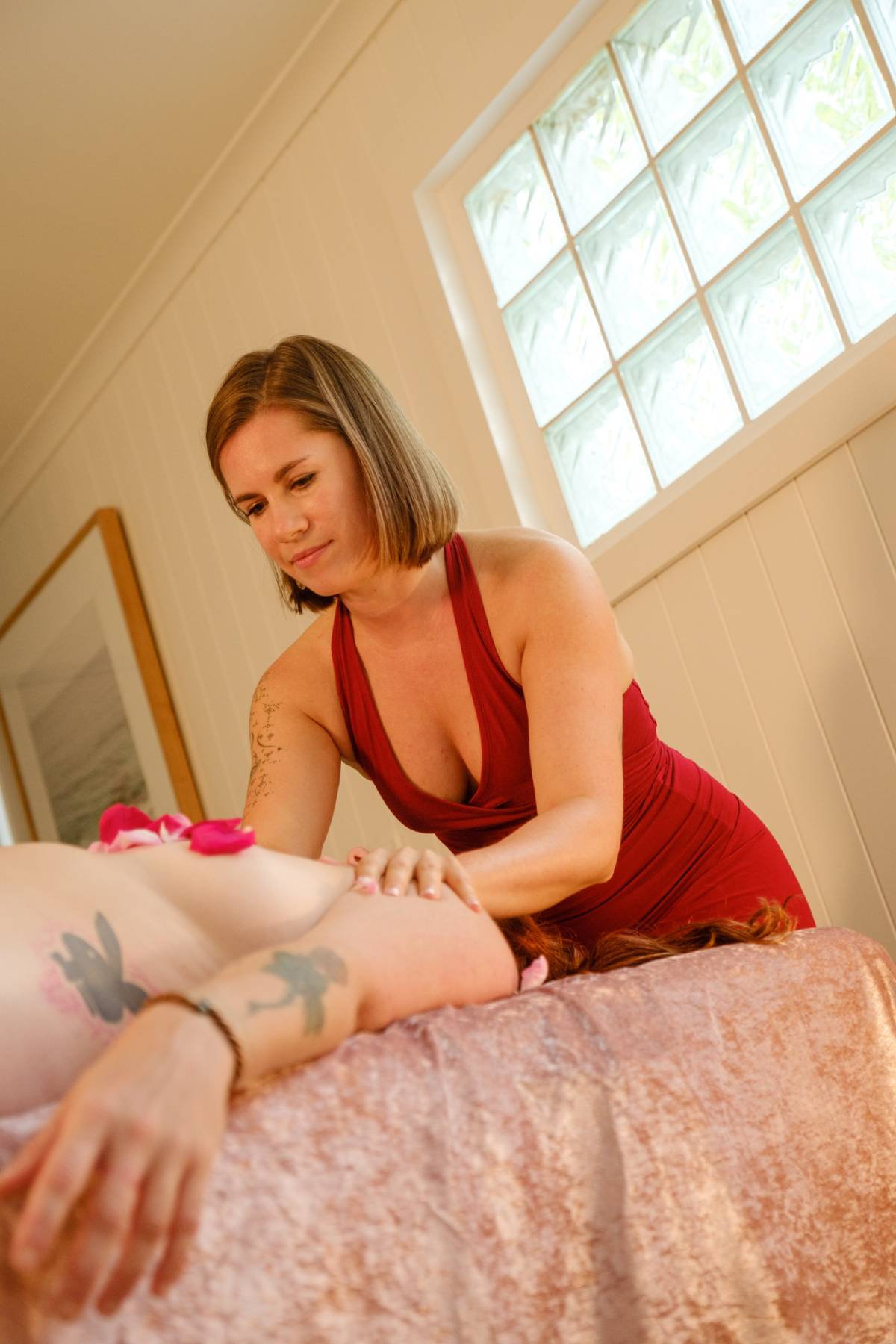
When I explain therapeutic yoni massage, I describe it as a non-sexual massage for the female reproductive system, including the breasts, womb, vulva, and vagina. It’s a slow, attuned, and deeply respectful practice that emphasizes consent, body awareness, and nervous system regulation. Rather than doing something to the body, we’re listening with it.
The way I facilitate always includes open, ongoing dialogue throughout the session, and the person receiving is always in control – they set the pace, the pressure, and decide which parts of the body are touched or not touched. This creates a sense of safety and agency that many women have never experienced in intimate spaces.
While pleasure can absolutely arise during a session – and we don’t shy away from celebrating sensation that feels good – it isn’t the goal. The focus is more on shifting numbness or discomfort. That’s why it’s often referred to as a healing modality: not because something is “wrong,” but because the body is given space to soften, release tension, and feel again.
Ultimately, therapeutic yoni massage supports women in reconnecting with sensation on their own terms. It allows them to move tension out of the body and create room for more sensation and pleasure outside of sessions. And just as importantly, it encourages them to practice using their voices – to articulate their boundaries, needs, and desires – both in intimacy and in life.
The Voice of Desire: Truths About Our Sex Lives
If desire had a voice, what do you think it would say about how we currently approach sex and relationships?
Liz Gorga: It would probably tell most of us, “you’re overthinking it.” Desire lives in the body, so naturally, the biggest killer of desire is being in our heads. I see it every day with the women I work with, and I’ve experienced it firsthand. When we’re thinking, we aren’t feeling. And the moments when we feel disconnected from sex, pleasure, our libidos, or desires, it’s often because we’ve slipped out of the feeling body. When we stop thinking and instead tune into sensation, taking the body’s lead on what feels good, that’s when we start to have the sex we crave and the relationships that support us.

Truth About Desire Women Can’t Ignore
If you could whisper one unapologetic truth to every woman reading this about her body, her pleasure, and her right to desire, what would it be, and why does it matter now more than ever?
Liz Gorga: Your body knows best. You don’t need to fill your bookshelf with every book on sex and the menstrual cycle; you don’t need to sign up for more freebies on how to awaken your libido, or subscribe to a step-by-step method for better sex. You just need to pause, take a deep breath, and listen to your body.
It feels like right now, sexual healing work is becoming more popular – and that’s a good thing! But it’s also becoming trendy. As you shed the layers that have been holding you back in your erotic expression, it’s important not to replace them with another box to fit into. Your sexuality is yours, your erotic expression is unique, and you get to make your own rules, always.

Editor Note
Liz Gorga’s work reminds us that disconnection from our bodies is not a personal failure, but a learned response shaped by culture, conditioning, and silence. Through her perspective, we see how performance-driven ideas of sexuality often pull us further from ourselves, while presence brings us back home. The insight that lingers most is both grounding and quietly radical: desire does not need to be chased, corrected, or explained. It needs to be listened to.
What Liz models with clarity and care is that embodied sexuality is not about doing more, but about noticing more. When we slow down, honour our rhythms, and trust the body as the authority, intimacy becomes less about expectation and more about truth.
“Liberation begins the moment we stop asking what desire should look like and start honoring what it feels like. In that space, connection deepens, and self-respect follows.”
