
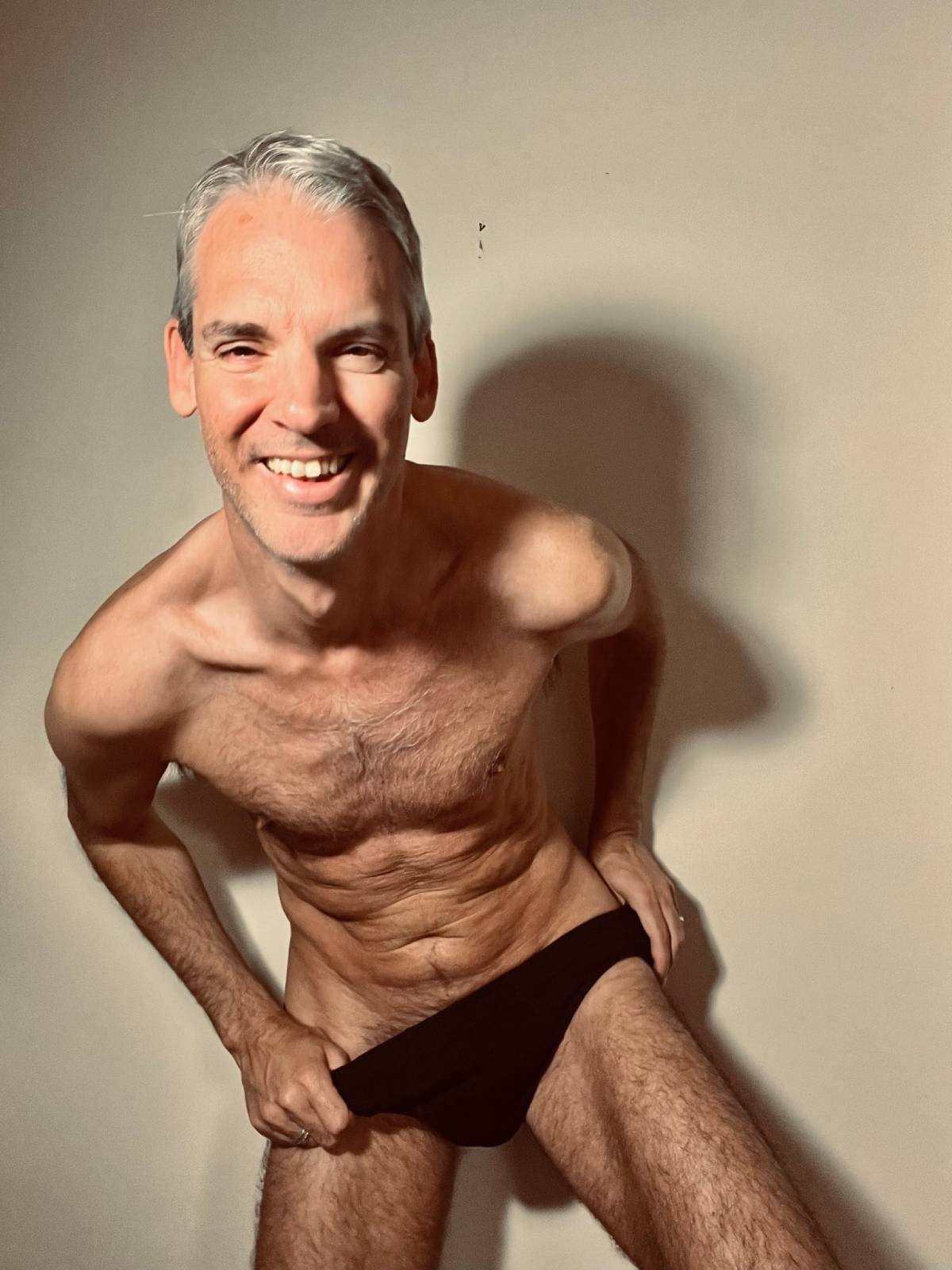
Michael’s journey into intimacy and self-discovery began with a leap into the unknown. At 40, he left a long-term monogamous relationship and a predictable gay life in London to explore his desires, sexuality, and the depth of human connection. What he found through his experiences was transformative: even brief encounters could create profound intimacy, moments of liberation, and unexpected healing. These insights sparked a mission to guide gay, bi, queer, and curious men toward authentic, confident, and embodied connection.
For many men, touch has long been coded as sex, and desire as something to be minimized or hidden. Michael’s work challenges these narratives. He helps men explore pleasure, consent, and boundaries in ways that are safe, conscious, and free from shame. By prioritizing presence, clarity, and communication, he empowers men to reclaim agency over their bodies, desires, and intimate experiences.
Honed over more than a decade, his practice blends trauma-informed Sexological Bodywork, the Wheel of Consent, and Sacred Intimacy. Unlike many traditional coaches, Michael offers hands-on experiential learning, sometimes involving the whole body, including arousal, always with choice, safety, and respect as the foundation.
As a Certified Wheel of Consent facilitator and member of the global teaching faculty for the School of Consent, Michael also trains professionals to bring these skills into their own work in non-erotic contexts. His workshops and guidance focus on helping men navigate consent, power dynamics, and erotic play ethically, joyfully, and confidently.
In this conversation, Michael reflects on reclaiming touch, exploring desire, and embracing intimacy beyond labels, expectations, or transactional norms. His insights illuminate a path toward authentic connection, self-trust, and pleasure, offering readers a candid, empowering look at how curiosity, courage, and embodiment can transform relationships with oneself and others.

Website
Personal Journey and Motivation
Can you share the experiences or moments that inspired you to focus on empowering gay, bi, queer, and curious men in their intimacy? How has your personal journey shaped the way you approach touch, desire, and connection in your work?
Michael: I had a somewhat predictable ‘midlife crisis’ when I hit 40, and I left a very long-term monogamous relationship and a ‘secure’ gay life in London to explore myself and who I could be, especially sexually.
As my erotic encounters with others increased, I quickly realized that the deep connections being created during these, even if only for a few hours, seemed to be having a transformative impact on my partners and me, often enabling a level of intimacy that felt unexpected, liberating, and even healing.
As I became more conscious of the impact I was having by ‘just being me’ and following my instincts, I realized that I wanted to learn to formalize and channel these skills so that I could more consciously and effectively help other men.
I remember, at the time, sitting with one of my dearest friends in a field in New Zealand, saying somewhat to both our surprise, ‘I think I want to be a sex worker!’ But back then, my only frame of reference for that was escorting, and I knew that wasn’t quite what I meant…
However, my instincts were right! Over a decade later, I’m actually now working in exactly the way I couldn’t quite fully visualize back then. Now I combine my natural capacity for enabling permission with my body and the skills I’ve learned from years of training to bring integrity and care to learning spaces where men can practice physical intimacy, body to body with another man. What I offer is pretty unique in the UK, and I’m proud of that!

Understanding Consent in Depth
The Wheel of Consent is a cornerstone of your practice. How do you teach men to navigate consent in ways that are playful, empowering, and emotionally safe, while still being fully present in intimate experiences?
Michael: Although the Wheel of Consent does underpin all my work, I actually don’t tend to frame what I teach as ‘consent’; what I teach are skills for creating clearer agreements when navigating pleasure. So that, rather than simply ‘getting permission’ (which is how consent is often framed), it becomes more about both people navigating agreements, in real time, to reach more consensual clarity about what will, or won’t, happen between them.
I think being fully present is key to this. So many men have become distracted by sexual performance, both in what they expect from their own bodies as well as from others’ bodies.
The heart of my work is about helping people connect with what’s true in their body, moment to moment.
What this means in real terms is supporting people to be able to notice what they really want (as opposed to what they’ve been told they should want, or what they think they ought to want) and to ask for it, instead of trying to hint, or assume, or sneak it. And also to be able to notice their limits and learn how to speak up for them.
For men who are attracted to other men, navigating these things can often be particularly tricky. Most of us have spent a lot of our lives having to minimize our desires, as well as going along with and putting up with things we don’t want often in order to assimilate, or even in order to survive, because of our sexuality!
I think ‘empowering’ for gay, bi, curious, and queer men often means the permission to come back into connection with the parts of ourselves that desire something, or that want to say ‘no’. And being able to access those authentic parts of ourselves without fear, judgment, or shame is what creates emotional safety. And that’s what I offer.

When Power Becomes Intimacy
Intimacy often brings up questions of control, power, and negotiation. How do you teach men to engage in power dynamics consciously, playfully, and ethically, whether in casual encounters or long-term partnerships?
Michael: When it comes to power dynamics between men, especially in the bedroom, I think there are some interesting factors at play.
There are certain lived experiences, particularly around privilege, that moving through the world in a male (or male-reading) body brings.
In many ways, this means that physical intimacy experiences between men can happen on a relatively equally balanced level, in a way in which I think physical intimacy between men and women often can’t.
But what ‘power’ really means is your ability to exert influence and control, and also the ability to have a choice about what happens to you.
And so, even between men, there are wildly differing factors that will impact each man’s capacity to be able to access and speak up for his desires and his limits. Skin color, age, body type, weight, physical ability, and perceived desirability all play a part in making it harder for some men to feel confident in their own ‘yes’ or ‘no.’
For me, the key to navigating power dynamics, whether in long-term or casual relationships, is learning to understand what giving and receiving mean in a more nuanced way.
Typically, we tend to think of ‘giving’ to mean ‘I’m doing,’ and ‘receiving’ to mean ‘it’s happening to me.’ How we refer to giving or receiving a massage is a good example of this.
But what if you tell me that you want to take my clothes off and run your hands over my body because you enjoy the feel of it?
If I say yes to that request, I’m giving you the gift of access to my body (even though I’m not doing anything), and you’re receiving that gift (even though you’re the one taking action).
That’s not the same as a massage, although from the outside, what’s happening might look pretty similar one person rubbing their hands over another person’s body. But the intention is very different, and so is the experience for each person involved.
So for me, the key to healthier intimacy dynamics is being able to understand not only ‘who is doing the thing,’ but just as importantly, ‘who it’s for,’ and it’s that crucial second element that is often the game-changer when it comes to having more conscious and ethical experiences of pleasure.

The Reactions No One Expects
What’s the most surprising or unexpected reaction you’ve seen from men in your workshops when exploring touch or desire?
Michael: I remember in one of the earliest Wheel Of Consent workshops I facilitated, the pairing panned out such that for one particular touch practice, there were two pairs of (cis straight) men who ended up working together.
All four men initially had a lot of resistance to doing this touch practice with another man.
But by the end of the practice, what they’d experienced during it had helped them decouple touch from sex.
In their reflections afterwards, all of those men were blown away by the fact that the safety and clarity of the practice container had enabled them to touch another man, with care and tenderness and—yes—intimacy, without it being in any way sexual.
Although this wasn’t at all surprising to me, it was an incredible lightbulb moment for those men who were able to move past a lifetime of conditioning that told them touch is sex.
It’s a theme I’ve also seen play out in workshops I’ve run for queer men, seeing the surprised, delighted (and often relieved) reactions when guys realize that desire, or touch, doesn’t have to equate to being sexual.
So many spaces for men who are attracted to other men are focused on sex as the default outcome; again, the message that’s been internalized is touch = sex.
I love creating spaces where having the possibility for touch and desire (and even arousal) to be present without it leading to sex is often a genuinely revolutionary experience for many queer men.

Curiosity Is Not a Crisis
Desire isn’t always straightforward; sometimes it’s messy, conflicting, or surprising. What advice do you give men who are curious about exploring touch or intimacy with another man but feel paralyzed by “what does this make me?” questions?
Michael: When I talk about desire, what I mean by it is an impulse that comes from deep within you (as opposed to an external pressure or conditioning) for something that you want, which is going to benefit you or bring you enjoyment in some way.
Sometimes our desires are achievable, and sometimes we have desires that may never be possible to meet, but that doesn’t mean we don’t still have the desire, or that the desire is any less valid because it’s not achievable.
I regularly work with men who are uncertain about having desires that involve other men and what those desires mean, especially if they involve touch.
Where I invite them to start is at the level of sensation, and here’s why:
There are 3 elements involved in an experience of pleasure: the first is sensation (the data that’s coming into your senses through your skin or body). The second is the context, or the meaning you give to what’s happening (a hug from a partner at home is going to feel very different from a hug from a random stranger on a crowded bus). And the third is where you place your attention (if you’re doing your mental knitting while you’re having sex you’re likely to experience less pleasure than if you focus on what’s actually happening).
When you follow, with curiosity, a desire for touch, and then you bring your attention to whether, and how much, you enjoy the sensation in your skin from the touch, you start to become present with what’s real for you.
And at least in that moment the other stuff, the stuff that can paralyze, becomes less important.
Sensation helps it become as simple as ‘do I enjoy this?’ or ‘do I not enjoy this? ’. And if I’m not enjoying it, what do I want instead? For me that’s the most important starting point for any exploration.

Swipe Culture vs. Real Touch
Some argue that dating apps have made physical intimacy more transactional. What’s your take, and how do you guide men to find real connection in a swipe-heavy world?
Michael: As someone who spent 10 years living remotely in the Scottish Highlands, where the nearest gay venue was several hours away, I genuinely appreciate how apps have made it more possible for many people to access other people like them in ways they couldn’t as easily before.
That said, I also understand how apps can make physical intimacy more transactional; I was listening to a podcast recently where they were discussing the ‘gamification’ of desire, where hookups cease to be about the human beings involved, or even about pleasure, and are simply about how many notches there are on the bedpost.
But I do think it’s absolutely possible to recognize all of that and do things differently.
For me, the key has been communication.
When I use apps, I’m very clear about what I’m going on there for. I take a second to check in with my intention before opening the app: do I want to chat, do I want to flirt, do I want to meet for sex…?
I’ve also changed the language I use on the apps. In my profile and when I’m talking, I’m very clear about what my intention, or my desire, is. Sometimes a quick fuck is exactly what’s wanted, and that’s OK. And sometimes I want to create more of a connection before meeting someone. Being clear with myself about what I’m looking for changes how and what I communicate, which in turn makes it easier for the guys who want what I want in that moment to respond to me.
When it comes to language, I’ve also stopped asking guys what they’re ‘into’ and started asking them what they enjoy doing when they play with another guy. It’s a subtle shift but it changes the kind of answers I get even if the general things people say they like are similar to previously, the way they talk about them is rooted more in pleasure than transaction.
I also encourage honesty, trying to be all things to all men isn’t just unsustainable, it masks the vulnerability of giving voice to my true desires or limits, which is actually the key to creating authentic connection.
So: get clear about what you like, what you don’t like, and what you might be curious about, or open to exploring, and communicate that clearly.

Beyond Top, Bottom, Vers
Is “top/bottom/vers” labeling doing more harm than good in 2026 queer dating? Have you seen men liberate themselves from those boxes through body-based exploration, or do they actually help clarify desire?
Michael: I think this has parallels with the apps. And, similarly, if we’re talking about labels that reduce complex humans to a single function, there are bad points, but I think there are also some good ones too!
I’ve found ‘top/bottom/vers’ (and more recently ‘side’) to have their uses as almost universally understood shorthand. Even though my own relationship with my roles in the bedroom has shifted and grown more complex over the years, I’ve found it handy to be able to use single labels or combine them to give a baseline indication of what I enjoy or what I’m looking for as a starting point for more discussion.
But, as I mentioned previously, I do think more useful questions to ask are: what do you enjoy doing with another man?” What brings pleasure to your own body? What is it that you enjoy about another man’s body?
Those questions will help you get to the heart of what you want from an interaction.
Because it’s possible to be a bottom who wants to be fully in charge or ‘bossy,’ and it’s also possible to be a bottom who wants to be dominated and told what to do. It’s possible to be a top who’s very active and is all about his own pleasure; it’s also possible to be a top who gets his pleasure from being of service to the bottom. And that’s not even getting started on the myriad possibilities offered by ‘vers,’ or ‘side’!
I will say, though, that even in sessions with clients, the shorthand can be helpful; sometimes it’s the only language they come into the room with, so it’s where we have to start.
But through the exploration of their own relationship with desire, touch, and pleasure in their own body, they start to understand more nuance, so ultimately even if the language stays the same, the breadth of what they’re able to ask for, beyond the labels, is much greater, and I think that’s the important thing!

Who Are You Really Having Sex For?
Do you think society’s obsession with sexual performance harms authentic pleasure? How should men reclaim intimacy for themselves rather than for validation?
Michael: Performance is based on trying to reach a particular goal or outcome.
Pleasure happens when there’s curiosity about what’s possible and where that might lead.
Performance often comes with a lot of pressure; if you don’t reach the expected outcome, it’s easy to feel there’s something wrong, and most people usually assume that means there’s something wrong with them!
Because of that, I think of pressure as being the enemy of pleasure. If you feel like there’s something wrong with you, it’s going to be much harder to access enjoyment!
My approach when I’m working with men is to support them to shift from a focus on ‘doing the thing’ to ‘having an experience.’
If your focus is entirely on doing a particular thing, for example, getting an erection or ejaculating, and that doesn’t happen, then it’s likely to lead to feelings of failure, inadequacy, or shame.
If you bring your focus instead to noticing what genuinely feels good in your body, moment to moment, it allows for more flexibility.
So, for example, you might be doing something which feels incredible for a while, but then the pleasure lessens; maybe you even reach a point where you’ve had enough, or it’s uncomfortable…
Instead of asking yourself, ‘What’s wrong with me? I said I wanted this; why am I not enjoying it? ’, If you ask yourself, ‘OK, I’m not enjoying this anymore, what do I want instead?’ it opens up so anymore;many more possibilities for continuing the pleasure and the connection in other ways, rather than shutting it down because it’s not fitting the script.
That in itself is validating; it’s telling your body that you trust it and you value it, instead of blaming it or overriding your own limits.
One Week, One Bold Shift in How You Connect
Hungry to bring more honesty, confidence, and joy into their intimate connections with men, what’s one actionable, Sin Edit-level bold step they can take this week, whether solo, with a partner, or in exploring new connections?

Michael: Get more selfish!
You have to start with yourself first if you don’t know what feels good or turns you on, how can anyone else be expected to?
Sex and intimacy definitely get better when you take responsibility for your own arousal. Think how hot it is when a guy is proactive about his desires in bed, when he takes ownership of what he wants to do, and fully inhabits his enjoyment of doing what turns him on… chances are he’ll feel the same way about you being proactive too!
Practice asking for what you REALLY want, not what would be OK, or ‘that’ll do’; not what you’ve gotten used to asking for; not what you think you ought to want.
Really start to notice all those impulses you have towards something you want. And start acting on them.
And start small. Asking for what you want can feel very vulnerable, so don’t try to jump straight into this in the bedroom. Build the muscle slowly with things where the risk feels less or the stakes aren’t as high:
If the deli doesn’t get your sandwich order quite right, ask them to adjust it instead of paying for something you didn’t really want and then moaning about it afterwards (I’ve been there!).
If your friend forgets to do that thing they promised for you, remind them (kindly), rather than just letting it slide because it’s too much trouble, or you don’t want to seem annoying.
There’s something about noticing and valuing your own desires, no matter how insignificant or trivial they seem, prioritizing them, and (crucially) taking action for them, which is the cornerstone of almost everything else I teach and coach and provides the foundations for honesty, confidence, and joy!
If you want some help with this, check out my fun 5-day Follow Your Impulses challenge: https://www.wheelofconsent.coach/follow-your-impulses/
Editor Note
In a world that teaches men to perform, label, and prove, Michael’s insights return us to something deceptively simple: honesty. Not the kind that impresses, but the kind that listens inward first.
Intimacy as an evolving dialogue rather than a fixed identity. It asks us to consider not just what we are doing in a moment of connection, but why and for whom. That shift alone can change everything.
Pleasure deepens when we trust our own sensation enough to speak from it. When we move from performance to presence, from assumption to agreement, intimacy stops being something to achieve and starts becoming something to experience.
And that, in itself, feels like freedom.
