
In a world overflowing with advice about better sex, stronger relationships, and endless ways to reignite desire, Juliette Karaman offers a perspective that moves in the opposite direction. Rather than encouraging people to accumulate techniques or chase novelty, she invites them to slow down, pay attention, and return to the quiet intelligence of the body. Drawing from decades of work across trauma therapy, nervous system regulation, orgasmic meditation, BDSM, and embodied practice, her approach challenges the idea that intimacy is something we achieve through performance.
Instead, she argues that genuine connection begins when we strip away the layers that have taught us to disconnect from ourselves.
That philosophy has been shaped as much by lived experience as professional study. Juliette’s work reflects an ongoing process of following what she describes as the body’s own breadcrumbs, bringing together seemingly different disciplines into one integrated understanding of how emotion, sensation, memory, and pleasure coexist. Throughout her career, she has explored how trauma, conditioning, language, and culture influence not only our relationships with others but also the relationship we have with our own bodies.
At the heart of her work is a belief that presence is a skill that can be cultivated, consent extends far beyond words, and healing often begins with the smallest moments of awareness. Whether speaking about nervous system regulation, power exchange, or the subtle signals our bodies communicate every day, she encourages people to replace judgement with curiosity and performance with genuine attunement.
In this conversation, Juliette reflects on why intimacy is less about adding something new than rediscovering what has always been there. Together, we explore embodiment, trust, pleasure, trauma, and the quiet power of listening to the body before it has to shout.

Website
Stripping Back to Real Connection
Say that intimacy isn’t something we need to add to but something we need to strip back. In a culture that constantly sells us more techniques, more products, more performance, what have we forgotten about genuine connection?
Juliette: I love how everyone teaches you that you have to add, and you have to have five ways to blow his mind, et cetera, et cetera. Actually, what we’re forgetting is that the actual work is doing the work by stripping it back. By stripping it back to emotions, to sensations, to what’s going on in your body. Can you recognise that, and then can you actually communicate what you would rather have instead?
I always think about it from when I was in orgasmic meditation and the 15-minute stroking of a clit by a finger, so slowly and so softly. You’re slowly stroking the skin of your eyelid because it’s that sensitive. The clit is even more sensitive. We’ve been so conditioned by porn, by romance novels, and by society to think that a woman should just be turned on, and it should be wham, bam, thank you, ma’am. When you actually look at the research in Sheri Winston’s Women’s Anatomy of Arousal, which came out in 2010, so much of it had never been done for women. We did not realise that the clitoris lives way further down. So we start adding toys. I’m not saying that toys are wrong or that more stimulation is wrong, but when it becomes more and more and more, at one point everything is going to feel a little bit boring.
The common thread for me between orgasmic meditation, erotic blueprints, the touch languages, BDSM, trauma therapy, and nervous system healing is that they’re not separate words. They are all what happens inside a body, inside us, inside our emotions.
What emotions are we having? How is it holding us back in life? How have we been conditioned to think about sex? Where does even a word like pussy really trigger people? This, of course, completely depends on where you live.
For me, also, when I moved to the UK with my two sons and then I got pregnant with twin girls, I asked my husband’s cousin, “What do you call a vagina? What do you call pussy?” She’s like, “Front bottom.” I said, “That is fucking confusing. Oh my god.”
We are complete people, and if we do not look at where we are conditioned and where we are running patterns, especially now with Andrew Tate and his brother being picked up by the manosphere and with Trump, who openly talks about grabbing pussy and “Oh yeah, that’s just locker room fun”, where men are being put on a pedestal when they act in a certain way. This loads into women’s bodies.
Thank God there are fucking loads of men that do want to learn more and that do want to cultivate presence. Presence you do cultivate. BDSM is one of the ways that you can cultivate presence because your attention is out. You are looking at that person in front of you, and you are noticing every single bit, or that’s what a good Dom does. Not the angry people that you see or the Andrew Taits of the world, where they’re just angry and lashing out at people. No, the Dom is the person that’s in service. They’re about five years in, and they used to be all hot and heavy. All of a sudden, they just noticed that things weren’t so exciting anymore.
That early hit is dopamine, and novelty is what fires it, so it fades. That’s the thing: novelty creates excitement. They start bringing in the toys and the tools and all the hot things. Soon they can only get off while he’s wearing his fireman’s hat. They go a bit further, and then in two weeks’ time she’s like, oh man, can you wear your fireman’s hat? It’s hot, but it’s starting to wane again, so she’s like, you know what, can you actually put on that fireman’s jacket? That’s hot! Oh yeah! Do a little striptease. Oh my god! That’s so incredible! They go on for a few weeks like that, and they just keep on adding and adding and adding and adding and adding because they’ve become numb, or sensationless.
In orgasmic meditation, we go through something which is called broken shards, and it feels like everything is so painful. A lot of times, people are numb, and they don’t realise that numb is actually also a sensation, but they go so fast at everything, just trying to add another layer on top.
While actually, it is taking layers off, like peeling that onion. We’ve heard that from thousands of coaches, but really, it is another layer, another layer, another layer in intimacy. Into me, you see.
Now, if we pattern interrupt it, and this is where I love to have a pattern interrupted, we turn it completely on its head. Just like when I tell my couples who come to me. They say they don’t have sex, and I give them homework: we are not allowed to have sex. They just look at me like, Yeah, right. We haven’t had sex in years; that’s why we’re here.
When you actually connect again, and you start to look at what you used to love doing together, what you appreciated about each other when you first came together, and when you even start looking at how you like things, things you may not be doing, the RAS, the reticular activating system, comes back online. All of a sudden, you start seeing things in a completely different way.
Presence can be taught, and we don’t even know that. We are scanning everyone else, except for what’s going on inside of our own cells, inside ourselves.
Genuine connection is intimacy. We can be intimate with girlfriends. We can be intimate with a stranger in tantra or in a speed dating group and tell them things that are on the inside of us. We find that really difficult to do with our partner or with our family.
One Philosophy, Many Practices
Your work bridges orgasmic meditation, BDSM, trauma therapy, and nervous system healing. Many people see these as completely separate worlds. What common thread connects them for you, and what do you wish more people understood about their relationship?
Juliette: My work bridges everything, and they’re not separate worlds, because they’re all talking about one person. One body. Emotional systems. And recognising where we may have been influenced by religion and by how we were brought up. Even a word as simple as “pussy” had such negative connotations, and now, over time, it’s become slightly more accepted.
I remember when I moved here with my two sons from Switzerland, and I got pregnant with twin girls. I asked my husband’s cousin, What do you call a pussy? What do you call it with your girls? She said, Front bottom. I mean, how fucking confusing is that, right?
For me, it’s been following the breadcrumbs. What did I need? How did I even know that I was raped? With the touch languages, with the erotic blueprints, with the shamanic training I’ve had, on top of all the other things, each one was a way to open up more, to actually peel that onion, that layer, more and more and more.
Especially now, with the Andrew Tates and the whole manosphere. With Trump openly bragging about grabbing women by the pussy and brushing it off as locker room fun. With women’s rights being totally turned back. Even Charlie Kirk, telling young women to reject feminism and submit to their husbands. Where is that brainwashing coming from?
Every step, every modality, has given me skills, has given me what I needed, not only for myself but for my clients. The BDSM became a way of getting to a static state so that other women who’d been raped could get to that state without having to go into the story of what happened, which is so traumatising and so emotional for them.
Between that and the metaphysical and the training of trainers, all of those tools now come in super handy. Adding the EMDR, the eye movements, on top of it all. It’s a whole system. It’s kind of like a computer that’s being run by so many different things, and you just upgrade it every time with a new iOS or a new whatever it’s called. This is what I feel like I’ve been doing all my life. Adding more to it, going deeper into it, and going, ah, that’s that one little piece that I needed right here.
The Body Never Lies
One of your most memorable lines is, “Most of you are reading this with a clenched butthole.” Beyond the humour, what does that physical tension reveal about the emotional and sexual lives we’re living today?
Juliette: Most of you are reading this with a clenched butthole. I say it as a joke, and then I watch people actually check in and go, Oh my God, we really are clenching.
I remember when I first started telling people to unclench their buttholes. They’d check, and there it was. I know it well, because my mother taught me to clench our buttocks and pull our tummies in at the same time and put the boobs up. Maybe not so much for the boobs, but definitely not those two. How many of us are walking around with a clenched jaw and never notice?
Although I use it as a joke, there’s actually a lot going on in the anus. It’s a tight ring of muscle, the anal sphincter, and it clenches under stress right along with the rest of you. When the stress never really stops, it just stays clenched. It doesn’t let go when the danger passes. That grip runs on the same alarm system as your breath, which is why the clenched anus and the shallow breathing always travel together. It’s the same reflex as the clenched jaw. In Tantra we de-armour the anus itself, especially for men, precisely because that’s where so much gets held for years and never released. The anus stores it. When the body finally lets that grip go, the sensation floods back in.
Not only do I say it as a pattern interrupt so people recognise what’s going on in their bodies and go, ‘Oh shit, I am’, but breathing and unclenching those buttholes is genuinely important. When we’re constantly clenched, we’re tense, and that tension numbs us to every other sensation.
This is why I so often teach people about the felt sense. Most of us have a body vocabulary the size of a phrasebook. Fine, tired, stressed, okay. More words exist. Nobody ever handed us the dictionary.
So when you notice something in your body, don’t stop at knowing it’s there. Get curious, the way you would with a stranger you actually wanted to understand. What are you feeling, and where in your body is it? Does it have a shape, a size, a colour? Where does it begin, where does it end? Is it moving, and if so, which way, inward or outward, or is it static? If it feels stuck, ask it a strange but useful question: how would it move if it could?
This is the dictionary I hand people: the sensation vocabulary. You read down a column until a word lands, even approximately. Precision isn’t the goal. Contact is.
- Shape: deep, flat, elongated, spherical, column, circle, line
- Motion: falling, rising, opening, streaming, spiralling, bursting, gushing
- Vibration: buzzing, fluttery, zinging, quivering, shivering, throbbing, trembling
- Temperature: icy, cool, numb, warm, hot, glowing, simmering
- Texture: smooth, velvety, slippery, sharp, wavy, rough, bumpy
- Pressure: clamping, buoyant, pinching, full, heavy, limp, charged
- Whole body: light, calm, fidgety, jumpy, tingling, fuzzy, buzzing
- Skin: itchy, prickly, sweaty, clammy, flushed, sticky, dry
- Muscle: sharp, dull, weak, crampy, twitchy, shaky, soft
- Expansion: expansive, floating, fluid, radiating, streaming, relaxed
- A body that gets listened to like that, even once a day, starts speaking more clearly by the week.

The Language of Consent
Consent is often discussed as a verbal agreement, yet your work suggests it also lives in the body. What does embodied consent look like, and how can couples become more attuned to the subtle signals they may be missing?
Juliette: Trauma lives in the body. So do intense experiences, in how we remember them and in the way a freeze, an uncompleted trauma cycle, lodges in the body and stays there.
Think about an animal that gets frightened by something. It shakes itself off, and it’s done. We, as humans, when we’ve had an intense experience, don’t shake. We go quiet. We go inside. We might cry a little bit. The best way I know to explain it is to look at a toddler. It has a tantrum, throws itself on the floor, wails, cries, and gets it all out of its system, and within minutes it’s absolutely fine. It doesn’t remember it. It never lodged in as a pattern.
Now, consent. If we look at the Wheel of Consent and take all four quadrants. This comes from Betty Martin, and it’s four rooms instead of two. When you are doing it, and it’s for them, you’re serving. When you are doing it, and it’s for you, you’re taking it. When they are doing it, and it’s for you, you’re accepting. When they are doing it, and it’s for them, you’re allowing it. Most people live in Servin and rarely leave. The two rooms almost nobody was ever taught are Taking and Accepting, and that’s the real question sitting underneath all of it: where do we take our pleasure?
From there it starts layering. Which pattern you may be in. Which touch language? Which pleasure language? Which way is your way into pleasure? How you’re being touched by life. It becomes a really multi-layered thing.
Then comes the part most people miss. How often does the voice say yes while the body is saying no? I see this all the time when I do my touch map with people. They’ll say, “Oh no, I don’t like that; touch A or touch B,’ and then you look at the body, and the body is showing something completely different. The hair standing up on end, the goose bumps. People will swear they don’t like something, and the body never lies.
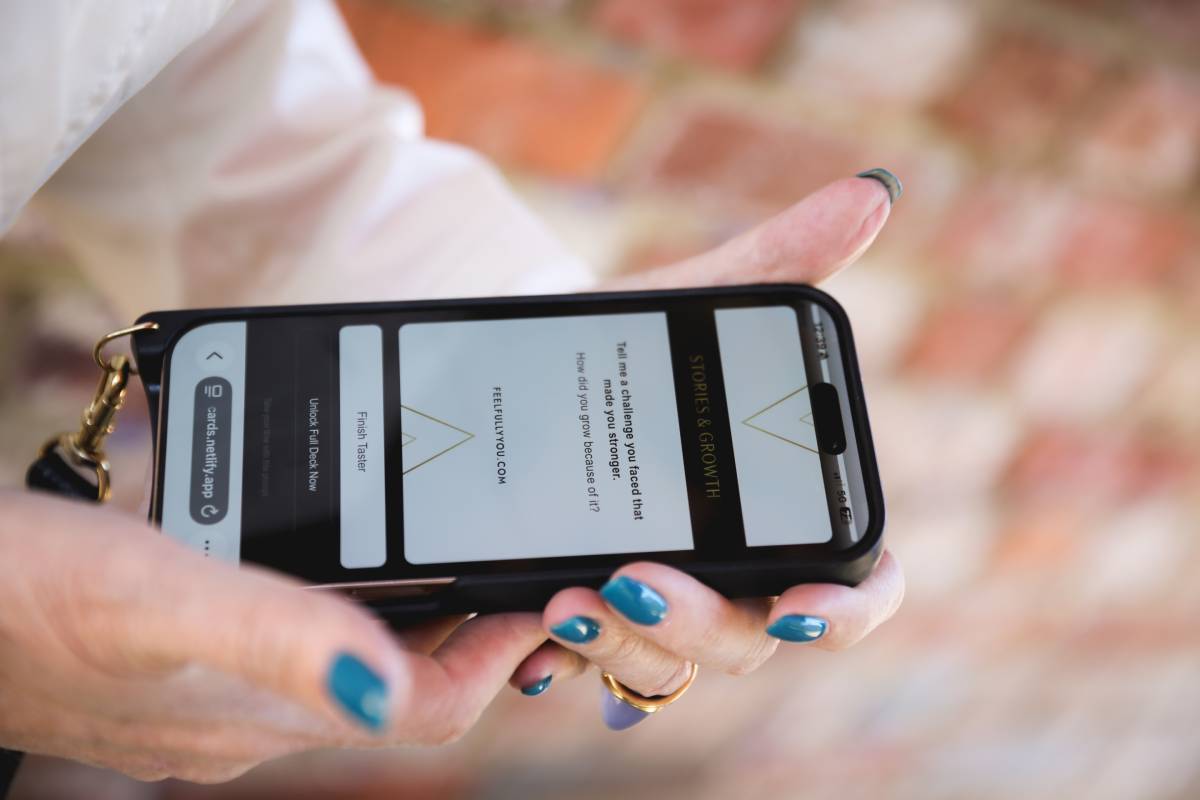
Verbal consent is very important too, and Alex and I were talking about exactly this weekend while we were playing my cards. One of them was, What do you need me to know about you and your sexuality? Another was, Tell me about a sexual encounter that was disastrous. Alex told me about a time when he was much younger, when he had sex with someone, and it really felt like she didn’t actually want the physical intercourse. What he’d tell his son, and my son, is this: when you’re getting hot and heavy, and you head to the bedroom, or wherever you’re having it, ask. Hey, do I have consent to have penetrative sex with you? It’s moments like that. Do we have consent, and do we both know we can always withdraw it?
That’s why BDSM taught me so much. You create a scene where a yes can always be withdrawn, and a no can never become a yes. That’s a pretty good rule of thumb for anything. Most BDSM containers also use the stoplight system. Green, everything’s good; keep going. Orange, this is getting a bit spicy; maybe slow it down a little. Red, stop. I’ve gone past my capacity, and red brings it all the way back to capacity.
How can we play with those edges? Because that’s where the growth is, and that’s where the sensation is, right there on the pleasure-pain edge. The good girl/bad girl of it.
If I look at the video where I had Ferne McCann, I watch him shove a raspberry in her face. Then I said, Close your eyes. I asked her, May I? She said yes. She gave me her consent. I told her exactly what to do, and then I just whispered in her ear, good girl. She just exploded. I touched her chest, her sternum, and that was it. That was the only thing I did, and this whole big frisson came over her body.
That’s the skill. How well can you read your partner, or whoever’s in front of you, and ask consent as you go, the way we do in orgasmic meditation? I’m going to touch you now. I’m going to touch your thighs here. I’m going to ground you. You’re actually telling them what you’re about to do.
My Tea Exercise does the very same thing. You get someone to make a cup of tea exactly the way the other one wants it, making adjustments until it’s just right, and let yourself receive that something exactly as you asked for it. Once you can do that over a cup of tea, you can take it into the bedroom. It’s a long answer, because consent isn’t one thing. It’s a whole conversation between two bodies.
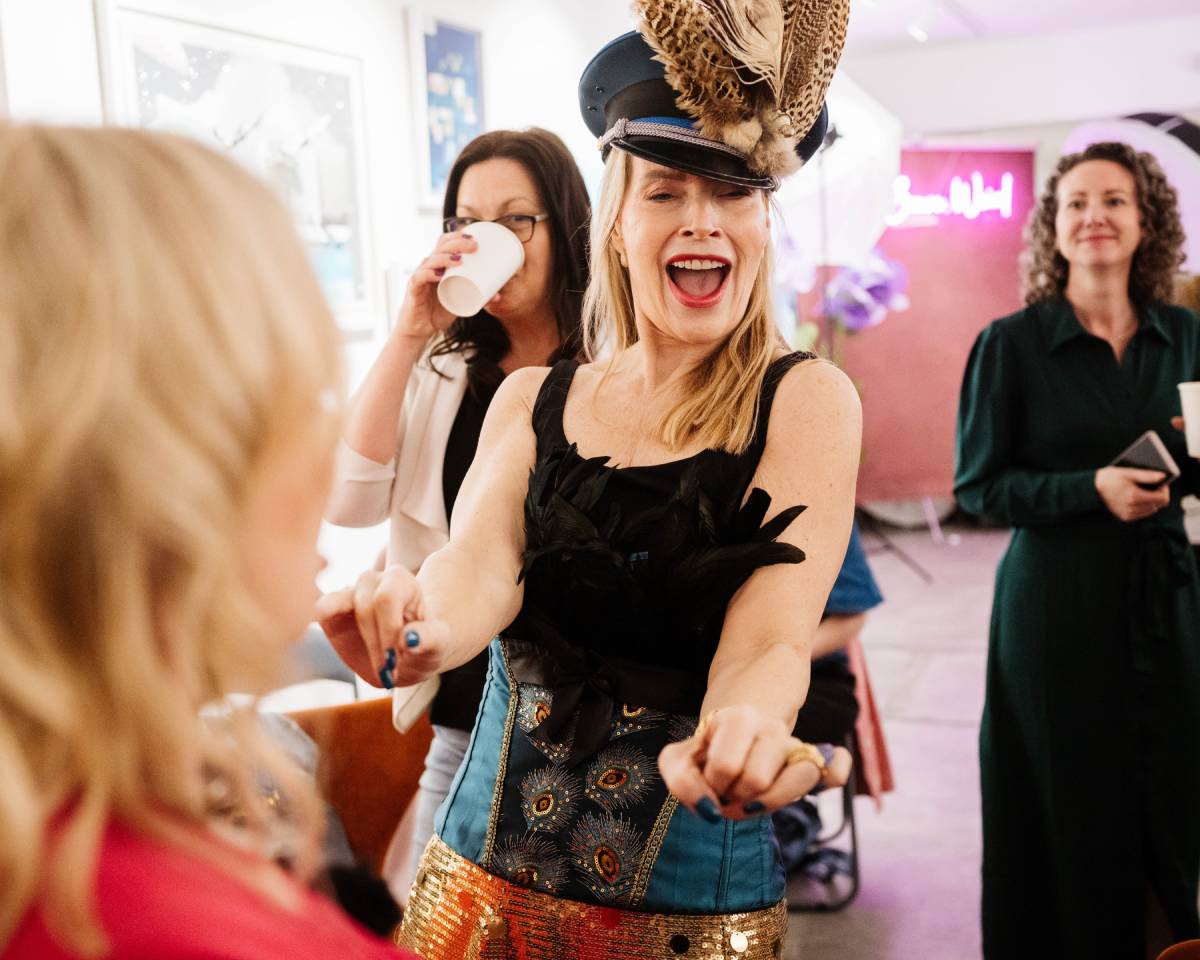
BDSM Beyond Fantasy
Power exchange can look intimidating from the outside. What emotional or psychological needs do you think people are often exploring through dominant and submissive dynamics?
Juliette: Power exchange looks intimidating from the outside. People assume that the world is about pain. It’s about trust, precision, and permission.
Most of the people who come to me wanting to submit are the ones holding everything up in real life. The capable ones. The ones everyone leans on. What they’re actually reaching for is to put the weight down. To be held, without having to be the one holding everyone. To be told exactly what to do so the nervous system can stop scanning the room and finally rest.
Earlier today I had a friend of my daughter’s here, a young woman I know really well, because I’ve also worked with her quite extensively on some of her trauma. She was saying, “Oh, I need really good instructions. I know a bit of her background, so I gave her very good, clear instructions to help me cook dinner and prepare things. She kept joking around. At one point, I walk up to her, and I say, May I? She just laughs a little and goes, of course. So I go behind her, I reach around her, and I let her lean back against my body. I say, take a breath. Then I whisper ‘naughty, naughty’ in her ear, and she starts laughing, and I go, ‘I didn’t tell you that you could laugh.’ I get her to look down, I touch her sternum, I say, ‘There’s a good girl,’ and I just leave. I walk away. She’s like, oh my god, how do you know how to do this? I read your body. I know what’s going on with you.
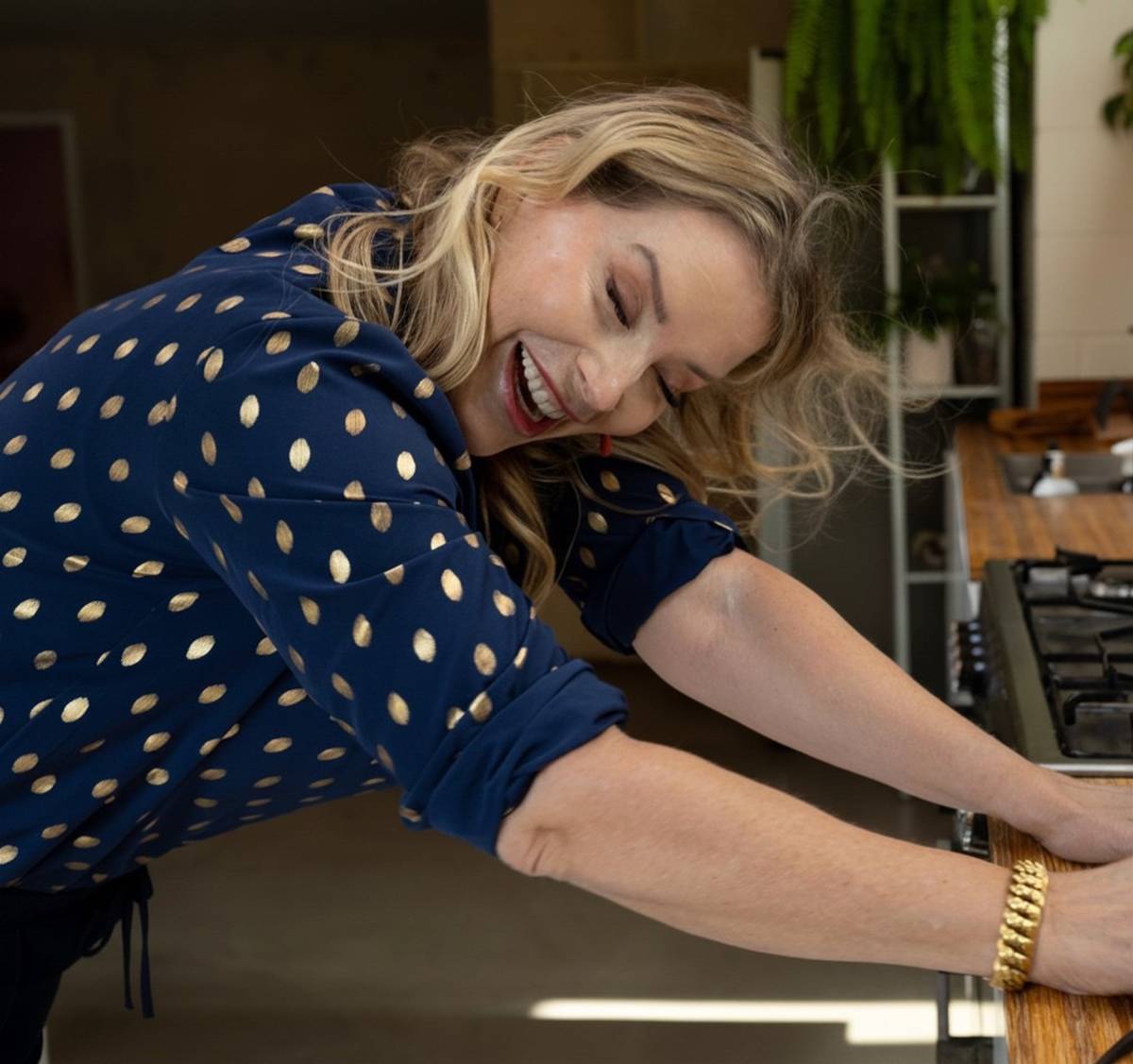
The beauty is that we can get to substates, to states that are so foreign to our normal way of being, just by being in this. It’s almost like a trance. What I’ve also seen in BDSM is that you can get to these beautiful states through physical impact. For me, it was flogging that released everything. It was under the flogging that I remembered my near-death and that I remembered my rape.
The most important thing, first of all, is to have consent. To say what your nos are and what your yeses are, which I talked about already. The stoplight system. Then, really, what is your aftercare? What do you each need, both as the giver, the dom, and as the receiver, the sub? What do you need to come down? Is it a cuddle? Very often I’ll say hydrate, so definitely water. I also make sure there’s no alcohol or any drugs involved for at least 24 hours before a container, before we go anywhere near this, because these can become such heightened states that it’s genuinely unsafe to go there with any intoxicant already in the body.
So don’t just read up about it. Read up, yes, and then perhaps go on a course. Find out from people who a safe person actually is. As always, your body is the compass for who’s safe. I’d advise against jumping on FetLife and going straight to the big dungeons, because a lot of that is going to be way outside your capacity.
We start small. My scenes usually don’t last more than 20 minutes, and people go, no, but we want hours. Your body doesn’t have the capacity for that yet. We can build up to it; we can build up to half a day. Some people love deprivation masks, being completely bound like a mummy. Kink is such a massive, massive arena. It’s such a big subject that people could genuinely study it for years, and there are so many nuances in it. But always, always, capacity. Start small. Say no. You can always change your mind, and next time you can do it again and go a little further. Build capacity. Five minutes, then seven, then ten, then fifteen. Check in constantly, every few minutes. Never just assume.

The Path Back to Pleasure
Pleasure can sometimes feel inaccessible for people carrying grief, trauma, shame, or chronic stress. What are some gentle first steps someone can take to reconnect with their body without feeling overwhelmed?
Juliette:
- Touch Base. It’s why I created the anchor so people can genuinely start to feel safe. Two minutes, twice a day. You bring your thumb to your forefinger, and you actually feel the ridges of your fingerprints against each other, slowly. The texture, the warmth, the smallest movement. Inwardly, you say, I am safe right now. You hold it for two minutes. That’s the whole practice. You can do it in a meeting, on a plane, in the school car park, or lying in bed, and nobody watching would know you were doing anything at all. Your fingertips are some of the most densely wired surfaces of your body, so slow touch there sends a very old signal inward: no emergency here.
- Five things. This is why I love bringing in the cards. Tell me five things that brought you joy today. Then tell me three things that were good today. We’re training the RAS, the reticular activating system, to start looking for what’s going well in our lives, because so often we’ve been trained to scan only for what’s going wrong.
- Self-touch. Again, it’s all about capacity. A short container. Three minutes of touching the inside of your own wrist. When I did this with a room of 73 women at my last live event, I was still speaking, and I watched everyone clutch immediately. Touch date, they’re thinking. We don’t do touch dates with each other. Or people instantly assume it means touching the genitals. No. It really doesn’t have to be that.
- Take care of yourself. This one is maybe the most important. Physical touch, and even off-the-body touch, energetic touch. Let’s be mindful; let’s be present. Take that body cream, or the hand cream you already have, set a timer for three minutes, and use your breath and your presence. What does it feel like to receive that, to give yourself that energy and actually let yourself take it in?
- Back to the felt sense. What’s the warmth? That’s the way back in. From there we return to the felt-sense vocabulary I gave you. Slowly, slowly, you start training your body to feel things again. We’re right at the beginning here. We’re so used to going fast that going this slowly can be hellishly uncomfortable at first. That discomfort is part of it. Stay with it, and the body starts to trust the slowness.

If every reader of The Sin Edit
Could leave this interview remembering just one truth about their body, sexuality, or capacity for intimacy; what would you hope that truth would be, and why does it matter now more than ever?
Juliette: If I could give the reader just one thing, it would be to start paying attention to their own body. To use your body as a compass. One of my clients texted me recently and said, ‘I cannot believe I’ve been tracking him all this time, and now I understand what you mean by tracking.’
I’ve been so focused on what he’s doing wrong, what he’s doing right, and what he wants, instead of where my body was already telling me, No, stop.

Editor Note
We often think intimacy is something we need to improve, perfect, or rediscover through new ideas. Yet the more we chase better communication, greater desire, or deeper connection, the easier it becomes to overlook the quiet signals already present within us.
The body has its own language. It notices tension before the mind does, remembers what words cannot hold, and often reveals truths we’ve learned to ignore. Listening to it requires less certainty than curiosity and less performance than presence.
As these pages unfold, you may find yourself paying closer attention not only to relationships but also to the subtle conversations happening beneath them. Sometimes the most meaningful shifts begin not with dramatic change, but with the willingness to notice what has always been there.
If your body has been speaking to you all this time, what have you been too busy to hear?
