
Lulu Sunnucks brings an unusual perspective to modern intimacy. A clinical sexologist and psychotherapist, she moved from two decades working behind the scenes with the global elite into trauma-informed therapy, experiences that shaped her understanding of what people carry privately and what it takes to create genuine safety.
Today, through her Erotic Intelligence Programme™, she explores sexuality as something we can understand, develop, and experience more consciously. Her approach moves beyond simply talking about sex, combining psychological insight with embodied practices that help people reconnect with their bodies, question inherited sexual scripts, and become more aware of what they genuinely want. At its heart is the belief that erotic intelligence is a skill, not an innate quality reserved for the naturally confident. scripts,
Her work spans individuals and couples across different orientations, identities, and relationship structures, while addressing everything from desire discrepancies and sexual difficulties to kink, consensual non-monogamy, and sexual trauma. Whether through private practice, workshops, or retreats, the focus remains on curiosity, consent, and helping people carry greater self-awareness into everyday intimacy.
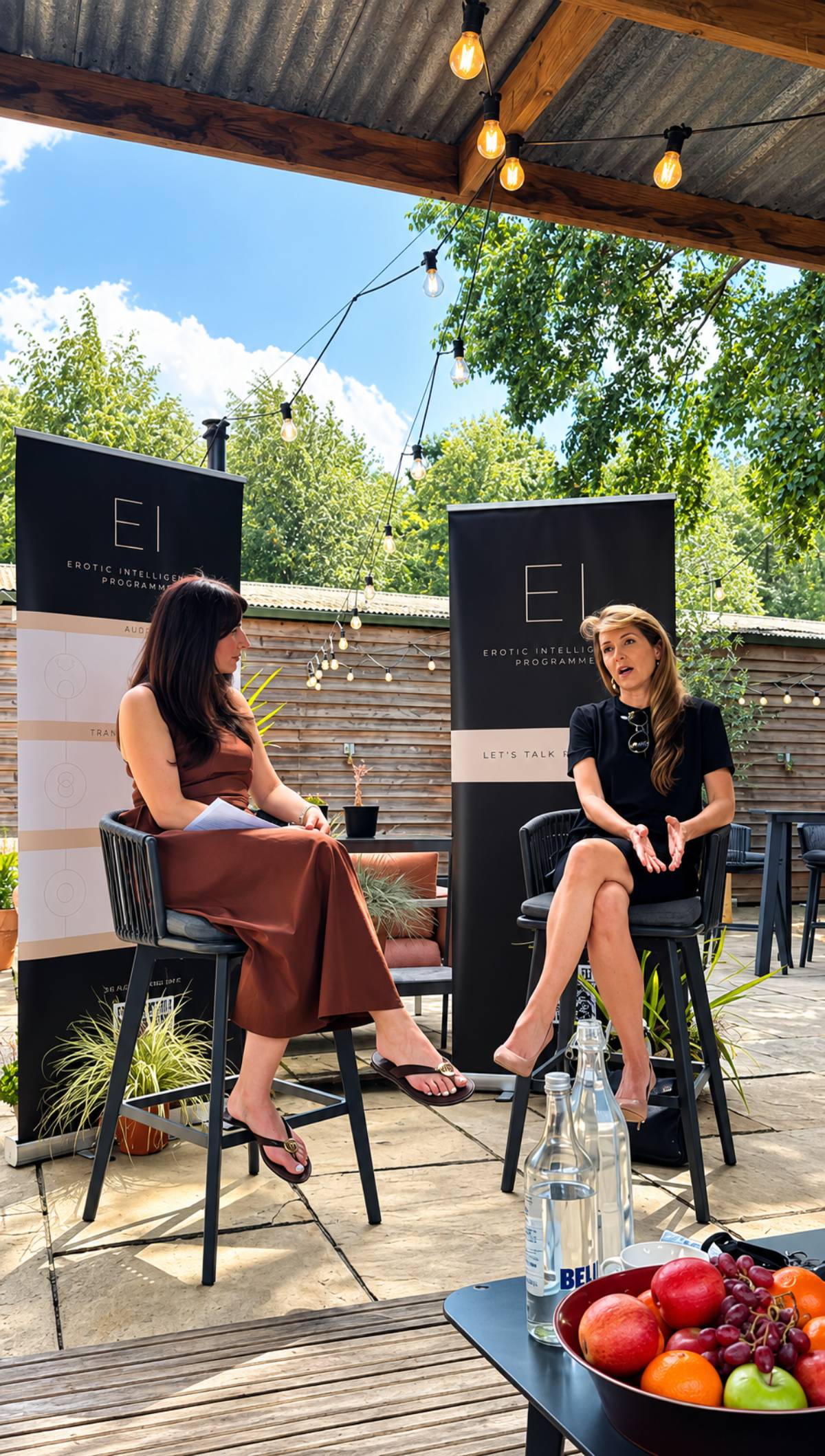
In this conversation, Lulu explores the stories we inherit about sex, the connection between the body and desire, the changing shape of commitment, and why fantasy deserves less shame and more curiosity. Her perspective asks us to look beyond what we think we should want and pay closer attention to what actually feels true.

Website
The Stories We Don’t Tell
Your path into sex therapy was unconventional, from working with the global elite to supporting survivors of sexual violence. What did these experiences teach you about what people hide and what they need to feel safe enough to reveal?
Lulu: I think those two worlds taught me the same lesson from opposite directions. Working as chief of staff for some of the wealthiest and most powerful men in the world, I learned that status, money, and a polished exterior don’t protect anyone from shame, loneliness, or desire going unspoken. If anything, the stakes of being found out are higher, so the mask is thicker. Then, working with survivors of sexual violence, I learned what it costs a person to carry the parts of themselves nobody is allowed to see.
What both taught me is that safety isn’t about how much someone has to lose or how dark their story is; it’s about whether the person in front of them is going to flinch, judge them, or see them differently. My job is to not flinch, to remain empathic, to stay non-judgmental, and to understand that everything makes sense with enough information. Once someone trusts that, they’ll tell you almost anything.
Are You Erotically Intelligent?
You describe erotic intelligence as something we can learn rather than something we either “have” or don’t. What does being erotically intelligent actually look like in real life, and how can someone tell when they are beginning to develop it?
Lulu: It looks remarkably undramatic. It’s being able to say what you want in bed without your heart rate spiking. It’s noticing you’ve gone through the motions of sex out of obligation and having the self-respect to name that instead of performing. It’s being curious about a partner’s desire instead of threatened by it. You know it’s developing when the shame volume turns down, when a fantasy, a boundary, or a “no” doesn’t come with a side order of self-judgement anymore. Erotic intelligence isn’t about becoming more adventurous. It’s about becoming more honest.
Erotic intelligence draws together everything the last fifty years of sex research has been trying to tell us. It takes the idea that desire is a life force best met with presence and breath, not rushed through. It holds the paradox that closeness and desire don’t always want the same things…love wants safety, and desire often wants a little mystery and distance, even in a committed relationship. It drops the idea of one “normal” script everyone should be measured against and gets curious about the real range of how pleasure works. And it understands that arousal isn’t a switch; we each have our own accelerators and brakes, desire is often responsive rather than spontaneous, and context matters as much as attraction.
In real life, that looks like knowing your own accelerators and brakes well enough to ask for what you need, protecting a bit of mystery even inside deep intimacy and measuring your pleasure against your own body rather than a borrowed standard. You know it’s developing the moment you stop asking, “Is this normal?” and start asking, “Is this really working for me?”
Where Did Our Pleasure Go?
Talk about reconnecting the “sexy brain” with the body. Why do so many people become disconnected from their physical experience of pleasure, and what can help them begin coming back into their bodies?
Lulu: We live almost entirely from the neck up nowadays; performing, achieving, managing, and sex have become other things to think our way through rather than feel our way through. Add years of messaging that certain bodies, certain desires, or certain levels of “effort” are the only acceptable way to have sex, and people genuinely lose the thread between arousal and awareness.
They can tell you what they should want before they can tell you what they actually feel. Coming back into the body starts with slowing everything down: breath, attention, sensation—long before it has anything to do with another person. You can’t reconnect to pleasure at speed.
Questioning the “Shoulds” of Sex
The Intimacy Audit™ asks people to become curious about their beliefs before trying to change them. What can we discover about ourselves when we stop asking “What’s wrong with me?” and start asking “Where did I learn this?”
Lulu: Everything changes. “What’s wrong with me?” keeps you stuck, because you’re treating a learned belief as a personal defect. “Where did I learn this?” turns the same material into a detective story, and almost always, you find the fingerprints of a parent’s silence, a school playground comment, a first sexual experience that went badly, or simply the culture you grew up in.
Once you can see a belief was installed rather than innate, you get to decide whether you still want it. That’s the entire difference between shame and curiosity, and it’s the hinge the whole audit turns on. Again, it’s asking people to check in with themselves, to ask themselves, “Do I want things to stay this way?” “How do I feel around this person I’m with?” “What do I really like and want? ”.

The New Rules of Commitment
Open relationships and polyamory are having a huge media moment. Are we genuinely redefining what commitment can look like, or are some couples using non-monogamy to avoid confronting problems in their relationship?
Lulu: Both, honestly, and I’d be doing the topic a disservice to pretend otherwise. I’ve actually written a couple of articles in the press about this recently. For some couples, ethical non-monogamy is a genuinely considered, well-communicated structure that fits who they are. It takes enormous self-awareness and more communication than most monogamous couples ever attempt.
For others, it’s quietly being used as a workaround, opening the relationship instead of having the harder conversation about why desire or connection broke down in the first place. The structure itself isn’t the issue. The question I always come back to with clients is, “Is this expanding something that’s already secure, or is it patching something that’s already broken?” Those are very different projects.
On Reclaiming “Sin” & Radical Empowerment
At The Sin Edit, we explore topics that mainstream society historically labeled “taboo” or “sinful.” What is one taboo or misunderstood aspect of human sexuality that you wish people would stop feeling guilty about and start celebrating instead?
Lulu: Fantasy. People carry enormous shame about what turns them on in their own imagination, as if a fantasy is a confession of who they really are or what they secretly want to happen. It isn’t. The mind is the safest place in the world to explore anything: power, submission, strangers, and scenarios you’d never actually want in real life, precisely because nothing there has consequences. I wish people understood that the richness of their fantasy life is a sign of a healthy erotic imagination, not evidence of something broken.
The goal isn’t to act on every fantasy. It’s to stop being afraid of having them and embrace it. We are not our thoughts, but our fantasies can reveal so much about where we would like sex to take us, what we might be missing, or what needs are desperate to be expressed.
Freud had a phrase for this—”polymorphous perversity,” which is the idea that, underneath the civilised adult exterior, we’re all capable of a much wider, messier range of sexual thought and feeling than we’re comfortable admitting. The uncomfortable, strange, or “wrong” thought isn’t a glitch; it’s baseline human wiring. Everyone has had a thought that startled them. That’s not pathology; it’s the mind doing what minds do. The goal isn’t to act on every fantasy, and it’s certainly not to feel guilty for having one. It’s to get curious about it instead of recoiling from it.

Editor Note
Lulu Sunnucks is how much of intimacy begins long before sex itself. So often, we approach desire through expectation: what we should want, how we should perform, and what a “normal” relationship ought to look like. Lulu gently disrupts that script by asking us to become more curious about the voices we have inherited and more honest about the ones we actually want to keep.
There is something quietly radical in that shift. Erotic confidence is not about being fearless, endlessly adventurous, or perfectly self-assured. It is about listening closely enough to recognise your own yes, your own no, and everything in between. Perhaps the most liberating idea here is that self-knowledge does not limit desire; it gives desire somewhere truthful to land.
The most intimate thing we can do is stop performing and start listening.
