
Sapphire Leela works in the space between what we are taught about sex and relationships and what we eventually have to learn for ourselves. A certified somatic sexologist and intimacy educator, and currently training as a psychosexual and relationship therapist, she works with high-achieving individuals and couples who may appear to have every part of life under control yet find themselves struggling with desire, recurring relational patterns, or the quiet disappearance of sex.
Her understanding of that gap is personal. She spent years performing intimacy, overthinking connection, and trying to be the partner she believed she was supposed to be, while her body was signaling that something was not right. At 21, a collapsed pelvic floor forced her to pay attention to those signals. Years of somatic and trauma work eventually reshaped her understanding of desire, consent, and connection: the body was never the problem; she simply had not been taught how to listen to it.
That realisation now sits at the center of her work. She is interested in the questions conventional sex education rarely addresses: what happens when desire disappears, how we recognise the difference between tolerance and genuine wanting, and how people can ask for more or something different without turning their desires into evidence that they are somehow “too much.” Her work extends across monogamous, open, and polyamorous relationships, with shame reduction at its heart.
In this conversation, Sapphire considers what conventional sex education leaves behind, why the body can recognise a truth before the mind does, and what dance floors can teach us about connection. Most importantly, she offers a gentler way of understanding sexual disconnection: not as evidence that something is broken, but as an invitation to listen more closely.

Website
Where Did We Learn to Love?
You describe yourself as teaching the “sex and relationship skills we should have gotten in school.” What was missing from the education you received, and how did that gap shape the way you experienced intimacy, relationships, and desire?
Sapphire: Sadly, it’s not only in the education I received, as I see in my work with people in Germany, the UK, the Netherlands, and Australia. Same gap, every passport. I hear the same sentence in every accent: “How come nobody taught me this?” We build entire school systems around understanding the mind and leave the body out of it completely, then hand people a relationship and a sex life and expect them to work it out alone.
Three things were missing, and they are the same three things missing for almost every client I sit with.
First and foremost, that a body shutting down or refusing to please is not a fault. When I did not get aroused, when I froze halfway through, when I was somewhere else entirely, it was not broken and not failing. It’s a body that is reading danger and protecting me. Knowing that would have saved me years.
Second, consent is something much wider than a yes or a no. Not only in bed. In every conversation, every touch, every room we walk into. And the difference between tolerating something, being willing to do it, and actually wanting it. Most people I work with cannot tell those three apart cognitively, not even inside their own body. They have been saying yes out of tolerance for a decade and calling it a relationship.
Third, that desire is a skill. How to relate, and how to lust. Where sex education exists at all, it teaches one kind of sex and one kind of pleasure. Nobody teaches desire as a skill you can build.
As for how the gap shaped me, I know the price because I paid it in full. I was in a relationship I genuinely loved and had no idea how to actually be in it. In bed, I knew roughly how long it would take. I made the sounds and the poses I had seen in films. Around the fifteen-minute mark, I would start wondering when it would be over so I could answer that email and deal with the pile of laundry in the corner. Four years of that.
At twenty-one, my pelvic floor collapsed. I could not control when I needed to pee. I went from doctor to doctor, and every test came back the same: everything looks fine. I knew, in the way you know things you are not ready to say out loud, that nothing was fine.
I was not a bad partner, and I was not broken. My body had not been failing me; it had been talking to me, and nobody had taught me the language. The training came afterwards. Everything I teach now is what I needed then, and I am still practicing all three of those skills every day.
What surprised me most is how far past the bedroom it went. Once I had them, the way I speak to my mother changed. The way I ask to be paid changed.

Too Much / Never Enough
One of the most compelling concepts in your work is the Too Much / Never Enough Loop. How does this pattern typically show up in couples, and what makes it so difficult for people to recognise that they’re both trapped in the same cycle?
Sapphire: Too Much / Never Enough is a catchy name I came up with because I kept hearing the same two sentences from opposite sides of the same bed.
One partner is convinced they are too much. Too many feelings, too many needs, too much talking, too many kinks, too many fantasies. The other is convinced they are never enough. Never wants to talk enough, never emotional enough, never sexual enough, never kinky
enough, never poly enough. They are describing the same problem from opposite ends, and both of them think it is a personal defect.
It shows up in the body before it shows up in the argument. One person processes fast. Fast heartbeat, wants it resolved now, follows the other into the kitchen. The other sometimes needs three days to think or feel, goes quiet, and leaves the room. The waiting itself becomes the wound for both. That mismatch was the single most common pattern in my research interviews, more common than dead sex.
It is difficult to see because it is not a decision. It fires like a reflex, below the conscious awareness level, faster than thought, and it fires in me too, even nowadays, knowing exactly what it is.
And because nobody has named it, people file it under how relationships are. One always wants more; one always pulls away. That is the plot of every romantic comedy and half of stand-up. It reads as normal and default.
Add sex, and it becomes unsayable. Try telling a friend you are too kinky for your partner or not sexy enough for yours. We have almost no shameless public conversation about this, and the silence is exactly what keeps it running. It crosses genders, nationalities, sexual identities and relationship structures. I have not yet met the couple who invented it.
Where Intimacy Gets Stored
As a somatic sexologist, you often emphasise that talking about a problem is not always enough. What are some of the ways the body stores relationship patterns, shame, or sexual disconnection, and what surprises people most when they begin listening to those signals?
Sapphire: I would put it slightly differently. The body does not store the pattern like a file in a cabinet. The body is where the pattern happens.
Sex is a physical event. Arousal is blood flow, breath, muscle tone, and hormones moving through a system that is scanning for safety the entire time. So when someone tells me they love their partner and cannot bear to be touched by them, I do not think that is a contradiction to talk through. I think their body has reached a conclusion their mind has not caught up with yet.
The evidence for this is not new. Van der Kolk built a career on it. Attachment research shows us rehearsing childhood patterns in adult beds. In my own practice, I see people who have done years of good talk therapy, who can explain their history perfectly, and whose pelvic floor still clenches on contact. The insight was real. It just never reached the tissue.
I can tell you exactly what it looked like on me. Years after all of this, my partner put a warm hand on my pelvis after sex and did not move it. He just stayed there, present. I broke completely open. What arrived was not an emotion; it was footage. Every evening I had spent fifteen minutes in and was mentally somewhere else. Every moment my body had been shouting, and I had not listened. It had been sending the same message for years, and I had never once received it.
What surprises people is the speed. I work with clients who arrive genuinely disconnected from the neck down, and within a few sessions they can tell me, “My chest just closed, my throat went tight, and I stopped breathing when you said that.” They become fluent. It is a skill, not a gift.
The second surprise is where it turns up. They come to me about sex. They report back about a meeting with their boss or even their own mothers.

Dancing or Dating?
You’re a festival and psytrance lover. Do you think people often experience more emotional authenticity on a dance floor than they do on a dinner date?
Sapphire: Almost every deep friendship and every significant lover in my life came out of a dance floor. Not a bar and definitely not a restaurant.
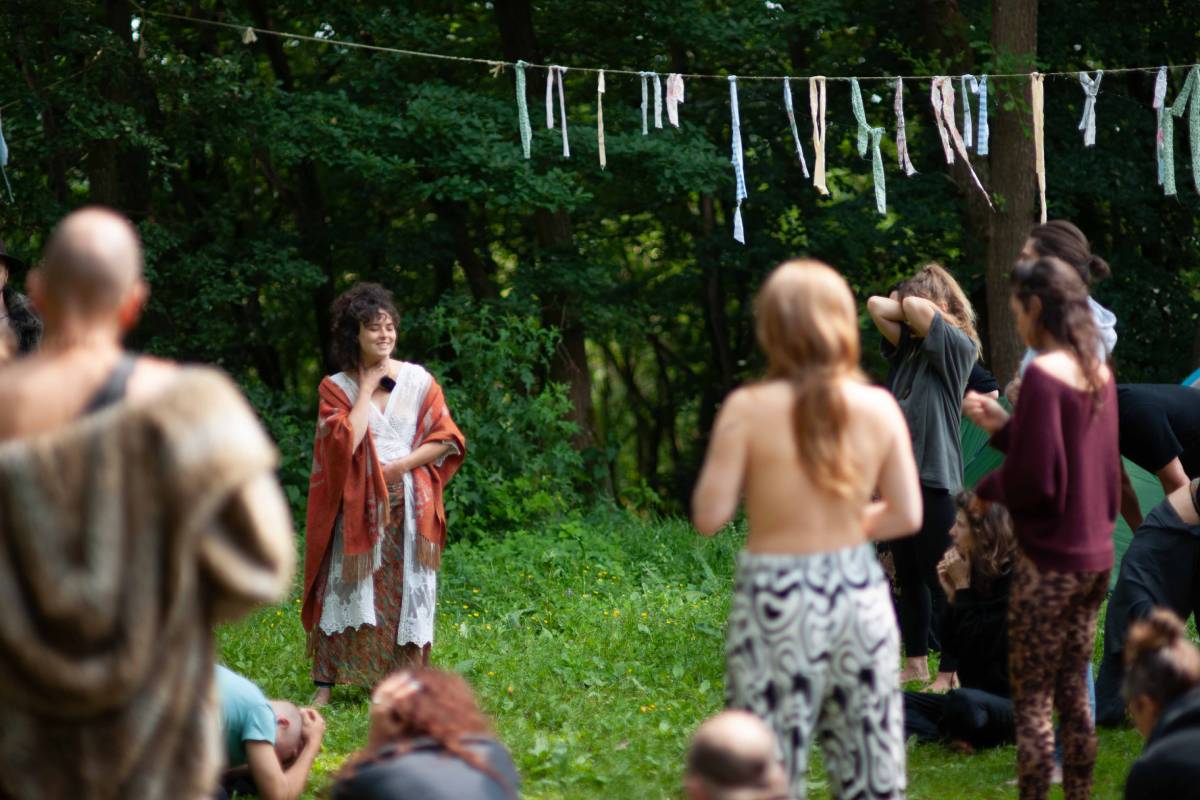
Here is what I think happens. Move with someone for two hours, and your breathing syncs, your rhythm syncs, and your bodies fall into the same time signature without either of you deciding to. You get to know a person by how they move next to you, which is much harder to fake than conversation.
Compare that to a first date at a restaurant. You are sitting still, facing each other, running the whole social protocol at once. What should I say? Am I saying too much? Am I listening enough? Who is paying? When do I reach for the bill? Underneath all of that, your body is quietly asking, every few seconds, Is this safe? That question consumes most of the available bandwidth, and then people wonder why they felt nothing.
On a dance floor, the protocol drops. The masks come off because there is nothing to perform and no bill.
I should be fair, because a room full of liberated people is not automatically a safe one. At a play party once, I went to get a glass of water. Two men started touching me at the water machine, and I froze. Could not move, could not find the words to make it stop, could not even reach the glass. Every person in that room would have stopped instantly if I had said one syllable. I did not have the syllable. Freedom is not the same as safety, and plenty of people feel real anxiety on a dance floor, so I would never prescribe it.
But the principle transfers. If you want to actually meet someone, put your body in motion. Walk. Swim. Go to the beach. Anything but sitting across a table auditioning for each other.

The Vulnerability Gap
You work with high-achieving individuals who are often successful in every area of life except intimacy. Why do you think professional success can sometimes coexist with deep struggles around sex, connection, and vulnerability?
Sapphire: Most of my clients were raised the way I was, headfirst. School, university, career. We are measured on output, numbers, and results. We learn to override the body, push through, perform, and deliver. That works. It genuinely works, right up until you get into bed.
Then the same operating system starts running on sex, and it produces a scorecard. Did I perform well? Was it good enough? Are we having enough of it? Was she/he satisfied?
People who are extremely good at solving problems meet a stalled sex life and reach for the only tool they trust, which is effort and measurement. There is no amount of trying harder that produces desire.
The other half of it is that vulnerability reads as weakness in every environment my clients and I have succeeded in. You do not show uncertainty in a negotiation. So we arrive with a lifetime of training in not being weak and then cannot understand why we are not being seen.
What I keep watching happen is the reverse of what they expect. Vulnerability is not the price of intimacy; it is the mechanism. It is also, and people find this hard to believe until it happens. To them, a turn-on. Brené Brown has spent twenty years making that case with the data. I mostly see it in real time, in the room.

If a reader of The Sin Edit
If someone is secretly struggling with a relationship where sex has become an obligation, a source of anxiety, or has disappeared altogether, what is the most compassionate and honest advice you would want them to hear right now?
Sapphire: Take one breath before you read the rest of this. A real one, all the way down. I spent years on your side of this sentence, so I am not guessing.
The honest part first. What you are living with is not rare, and it is not a character flaw. Right now, at one in the morning, an enormous number of people are typing some version of your sentence into the Google search bar and deleting it before they hit enter. I see it every week, in every age group, in every gender, in monogamous couples and polyamorous ones and everything in between. The private shame you are carrying is the most common thing in my practice.
The compassionate part. Your body is not broken, and it is not against you. A body that has closed is doing exactly what it was built to do, which means it can also open, and the tools for that are not expensive and not somewhere else. They are your breath, your voice, your movement, your touch. You already own all four. Most people have simply never been shown how to use them skillfully and usefully.
And it does not take years. When people start working with the body, change tends to arrive faster than they expected and slower than they want. But it arrives.
You are not too late, and you are not the only one.

Editor Note
We are taught to think of desire as something that either arrives naturally or disappears without explanation. We are also quietly taught to treat intimacy as something we should be good at: communicate well, give enough, want enough, and perform well. It is easy to confuse competence with connection.
But the body does not always follow the rules we have learned. It notices what we tolerate, what we avoid, what makes us tense, and what allows us to soften. Often, it responds before the mind has found the words.
Perhaps this is why desire deserves more curiosity and less judgment. There is a profound difference between saying yes, being willing, and genuinely wanting something. That distinction can change how we understand not only sex but also the ways we move through relationships, work, and everyday life.
Sapphire’s reflections offer a quieter way of thinking about intimacy: not as something to perfect, but as something to listen to. What we call disconnection may sometimes be a message we have never learned how to read.
What might you hear if you stopped asking whether you were doing intimacy correctly and started listening to what you truly want?
