
For Quinn Kush, intimacy begins long before sex. It lives in the quality of attention we give ourselves and others, in the courage to be witnessed, and in the freedom to inhabit our bodies without constantly editing what we feel. A pleasure artist, somatic practitioner, and founder of Tender Core, Kush explores intimacy, embodiment, touch, receiving, identity, and authentic connection, bringing together the physical, emotional, and expressive dimensions of pleasure.
Her perspective has been shaped by a personal search for closeness that ultimately revealed something deeper: pleasure can carry emotional and even spiritual dimensions when presence, honesty, and vulnerability are allowed into the experience. That understanding now informs her relationship with the body as a source of wisdom and information. Self-touch, for instance, becomes more than an erotic act; it can offer reassurance, grounding, and a way of reminding ourselves that we can return to our own bodies when life feels overwhelming.
There is a deliberate tension at the center of her philosophy. The “monk” represents stillness, surrender, and receptivity, while the “punk” embodies boldness, expression, and action. Kush sees both as essential when navigating desire, boundaries, and freedom. Rather than choosing one, she advocates developing the range to move between them with awareness.
In this conversation, she explores the emotional grounding, the truth beneath desires often labelled as kinky, the subtle bodily signals that can precede a boundary, and the importance of understanding our needs before frustration speaks for us. At its heart is a simple yet radical idea: Knowing what feels true in your own body may be one of the most powerful forms of liberation.

Website
What Intimacy Is Really For
Society tends to separate “sexual” experiences from “emotional” or “spiritual” ones. How did your own journey challenge that separation, and what did it teach you about the deeper purpose of intimacy?
Quinn Kush: It really began when I went looking for a lesbian sensual massage. I hadn’t experienced intimacy in a long time, and I was craving someone to guide me through an experience of closeness.
What I was looking for wasn’t just sexual pleasure. It was the energy of another person, the feeling between us, and what we could create together.
I’ve realised that, for me, pleasure is often deepened by emotional and spiritual connection. Don’t get me wrong, I can go to a sex party and have a wild, primal time. But that’s not my default setting. What really moves me is intimacy that asks for presence, vulnerability, and honesty.
And I think that kind of intimacy has become a rare breed of experience.
We live in this overstimulated, hard-and-fast Western world where so much of our connection is rushed, distracted, or performative. To actually sit with another person, be fully present, let yourself be seen, and allow genuine closeness to emerge can almost feel like a spiritual experience because it is so different from the way we normally move through the world.
That completely changed my understanding of intimacy. I stopped seeing it as something reserved for sex or romantic relationships.
Intimacy is a way of life.
It can be practised with yourself, your friends, your lovers, and in the tiny interactions of your everyday life. It’s a quality of attention and connection that, for me, makes life richer. And I actually think intimacy is one of the biggest missing flavors in our social culture right now.
My performance art has been another way of challenging this separation.
So much of what we see in mainstream culture around sexuality and sexual energy is performative—it shows us bodies, desire, and sexiness, but not always the vulnerability, emotion, tenderness, or meaning underneath it.
As a pleasure artist, I’ve wanted to create a different lens.
I’ve curated performances that bring the emotional and spiritual into conversation with the erotic, where sexuality can exist alongside tenderness, vulnerability, ritual, humor, connection, and genuine human feeling.
For me, that creates a much deeper dimension of pleasure. And perhaps more importantly, it gives people an opportunity to witness another possibility: that intimacy can be erotic without being only sexual, spiritual without being removed from the body, and deeply pleasurable without needing to perform anything at all.

Touching Yourself Back to Safety
One of the most intriguing aspects of your work is the idea that self-touch is not simply erotic but regulatory. How can intentional self-touch help calm the nervous system, reduce overwhelm, and create a greater sense of safety within the body?
Quinn Kush: Most people think of touch in general as erotic or sexual. I believe this is due to a lack of sexual education, people having their boundaries broken through touch, and a lack of knowledge around this art as a tool for so much more. I believe many people assume self-touch to be masturbation… but the first language of safety is touch. Self-touch is the most underused secret weapon when it comes to feeling connected to yourself. Not only that, but it can also lower our cortisol levels by up to 30%!!!!
Before we understood words, we understood pressure, warmth, rhythm, and holding. A hand on the chest. A body close by. A soothing presence. The nervous system learns through nonverbal sensation before it learns through explanation.
Intentional self-touch can be a way of telling the body, “I am here with you.” As contact to bring self into presence.
This is an incredible practice to rewire more safety in the body and create new (but ancient) strategies that can become powerful through repetition. The body begins to learn, “I can come back. I can be with myself even when it’s hard,’ and my favorite— ‘I’ve got you.’
My personal favorite times to engage in self-touch are in the sunshine. When I feel the sun on my body, it asks me to keep indulging in pleasurable sensations; caressing my skin is one of my favorites. Driving in the car when you are stuck in traffic, pissed off, or feeling stuck. Self-soothe and rub your chest. Can’t sleep? Stroke your face and hold yourself; you’ll have the best sleep!
This is another strong asset to treating yourself as a lover; embracing self-intimacy is caring for yourself in regulatory ways. Self-touch is waiting for you to choose it as a lifelong ally.

Tea by the Fire, Naked on Stage
The phrase “50% monk, 50% punk” captures a beautiful tension between stillness and wild self-expression. How do those two energies shape your own relationship with intimacy, sexuality, boundaries, and freedom?
Quinn Kush: This is such a good question, ahhh!
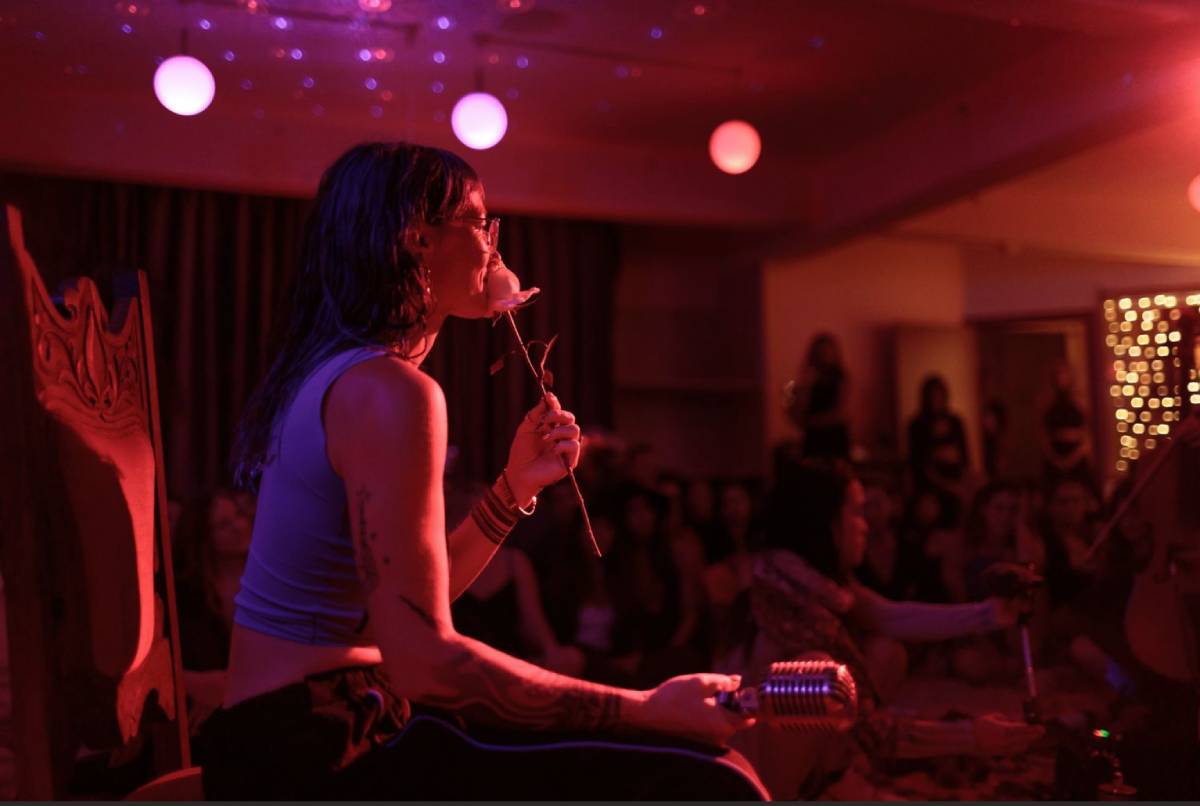
There is a part of me that wants tea by the fire, silence, ritual, devotion, slowness, prayer, and the nervous system exhale. And there is another part of me that wants to be naked on stage, laughing, disrupting shame, flirting with the edge, and making a room feel alive.
When I say “naked on stage,” I mean that quite literally and also symbolically. As a pleasure artist, I have performed and facilitated in spaces where the body, sexuality, humor, and ritual were visible. I created live experiences where nudity, touch, audience participation, erotic intelligence, and performance art were used to interrupt shame and invite people into a more honest relationship with their own bodies. It was not nudity for shock value. It was the body as a teacher. The body is saying, “What if this was not something to hide from?”
This is an incredible question because not only do I live by this in my day-to-day life, it is really the crux of Tender Core.
For me, the tender and the punk are about knowing when to go and knowing when to soften. It’s learning to move between the different forces that live inside of us:
Chaos and stillness.
Softness and fierceness.
Pleasure and grief.
Surrender and action.
Both are essential. Both have something to teach us.
The tender is our inner sub. It is surrender, softness, allowing, receiving, vulnerability, slowness, and stillness. It’s the part of us that stops trying to control everything long enough to let life actually happen through us.
The punk is our ‘inner dome.’ It’s wild expression, backbone, directness, and action. It’s the part that says this is what I want, this is what I don’t want, and this is who I am. It lights the fire of our creativity and gives us the courage to actually do something with it.
When it comes to intimacy, sexuality, boundaries, and freedom, I think we need both, and sometimes you might need to pendulum swing before you balance out, but the real key is strengthening the muscle for both and giving them space to both exist at the right times.
There are moments where freedom means being wild, expressive, and completely unapologetic about what we desire. And there are moments where freedom means slowing right down, surrendering, receiving, and allowing ourselves to be deeply affected by another person. I still struggle with this; as someone who loves to push the boundaries of what’s possible, it’s not sustainable to do this all the time. I need to know when to step back, enjoy some tea, and integrate experiences.
Even in the bedroom, when things are becoming hot, fast, and expressive, remembering to channel the inner monk and slow everything down can suddenly create so much more spaciousness for intimacy. And then maybe the energy builds again. You move between the two.
Fast and slow.
Expression and reception.
Taking up space and surrendering into it.
That rhythm is where I think so much aliveness lives. Too much punk, and we can become hard, reactive, or constantly chasing intensity. Too many monks, and we can become passive, withdrawn, or disconnected from our fire.
The practice isn’t about becoming one or the other. It’s developing the sensitivity to know which part of you is needed in each moment! To dance between these natural rhythms, internalizing to navigate the external.
To me, that is freedom. Not being permanently soft. Not being permanently wild. But having access to the full range of yourself and being able to move between those energies without abandoning either one. RANGE is the hottest quality, am I right?
Not Every Kink Is About Sex
What’s something people commonly label as “kinky” that you believe is actually a very normal human desire for attention, tenderness, or emotional safety?
Quinn Kush: Something that often gets called ‘exhibitionism.’
People hear that word and imagine it is only about being provocative, attention-seeking, or wanting to be looked at. And sure, there can be a thrill in being seen.
But the deeper desire is often much softer than that. It is the desire to be witnessed in your true sexual pleasure without shame.
To be seen while you are enjoying your body. To be watched without being judged. To be met in your aliveness instead of being made wrong for it. To feel that your pleasure does not have to be hidden, minimised, made polite, or pushed into the dark.
That is not weird to me. That is very human.
Being on stage was a huge kink for me. I loved the charge of being witnessed. But what stayed with me most was not the shock or the spectacle. It was the way women in the audience would sometimes weep watching raw, slow, sensual demonstrations of sapphic intimacy.
So many people have learned to make their pleasure private in a way that is not sacred but shameful. They hide their sounds, their face, their wanting, their softness, their boldness. They become sexually edited.
So when someone says, ‘I want to be watched,” I am curious about the emotional truth underneath it.
Whether they know it or not, often what they are really saying is, “Can I be seen in my pleasure and still be safe?” “Can I be desired without performing?” “Can I be witnessed without being judged?”
Personally, this is one of my versions of liberation, baby!

The Silence Between Yes and No
People struggle to identify their own boundaries until they’ve already been crossed. What are some of the subtle signs that someone has become disconnected from their body’s “yes”, “no”, or “not right now”?
Quinn Kush: The body gives the first signs.
The breath changes. The jaw tightens. The stomach drops. The body leans away while the face keeps smiling. The voice becomes higher or less certain. A momentary ‘split’ that is hard to put into words. You start mentally leaving the room or tracking the other person’s reaction more than your own truth.
These signals are information. Everything is information that can lead to knowing more about your pleasure. These are the body’s way of pointing us back toward the feeling underneath.
Sometimes it is not a strong no. Sometimes it is simply the absence of a real fuck yes!!!
That is important, because many people do not recognise anger or resentment straight away. Anger is not always socially acceptable for any gender, so a lot of us learn to hide it, soften it, intellectualise it, or turn it inward.
Resentment often arrives later.
This is why self-compassion matters. The point is not to shame yourself for missing the signal. The point is to gently forgive yourself, get curious, and keep noticing. One practical tip is to buy yourself some time when someone presents you with ‘yes or no’ questions; this can create the separation needed to disrupt the autopilot pattern. As well as this, explore your own body so you can get to know more about what you like and then be able to make that call from a clearer place too!
The practice is learning to respect the subtle signal earlier, before the body has to turn it into resentment. A moment-to-moment connection with your inner sensations and what they mean. This is true embodiment! This is also why I created Tender Core: to create live experiences for people to practice their yeses and noes. If you want results, stepping into the arena is the bravest thing to do. On your own terms, of course. One foot in front of the other.

Lesson: Most of Us Learn Too Late
What is one intimate truth you wish every adult had learned before entering their first serious relationship, and how might our collective experience of love and connection change if we were taught that truth earlier?
Quinn Kush: I wish we learned how to know our own needs. Everyone has core human needs, and these play an essential role in the happiness of our lives.
Honestly, most of us enter relationships knowing how to be desirable, easygoing, and low-maintenance; we are led by chemistry and having been told what we ‘should’ want. It’s sexy to begin with, but it becomes very exhausting to keep innate human desires hidden.
But we are not really taught how to ask, “What do I actually need here?”
NEEDS ARE NOT SELFISH. They are not some embarrassing little problem we have to hide so someone will love us. They are information. Needs bring us to self-care, deep true happiness, and real compatibility with ourselves!
We need safety. Touch. Space. Reassurance. Play. Rest. Honesty. Repair. Belonging. Sometimes we need closeness. Sometimes we need everyone to get away from us for five minutes.
When we do not know how to name our needs, they usually come out sideways. Resentment. Anxiety. Over-giving. Going quiet. Picking a fight about the dishes when it was never really about the dishes.
Because intimacy gets a lot cleaner when people can actually say what is true. “I need reassurance.” “I need space, but I am not leaving.” “I need tenderness here.” “I need to slow down.” “I need to be met, not managed.”
Knowing your needs does not make you selfish. It makes you ‘hot and whole’. It means you can love, desire, ask, receive and choose from a place that is actually yours.
That is the work I began as Quinn Kush, Pleasure Artist, and the work that has continued to evolve with me: helping bridge the gap between who people are now and who they are becoming, using the wisdom of somatics, intimacy, pleasure, and rockstar expression!!!

Editor Note
How much of ourselves do we edit in order to be loved, desired, or accepted? What stands out in Quinn Kush’s perspective is the invitation to stop treating the body as something to manage and start listening to it as a source of truth.
Desire, boundaries, tenderness, and even discomfort can tell us something if we are willing to slow down enough to hear it. There is also something liberating in the idea that self-knowledge is not the opposite of connection; it may be what makes deeper connection possible. Perhaps intimacy becomes most powerful when we stop performing who we think we should be and become curious about who we actually are.
The most intimate rebellion may be giving yourself permission to be fully, unapologetically real.
