
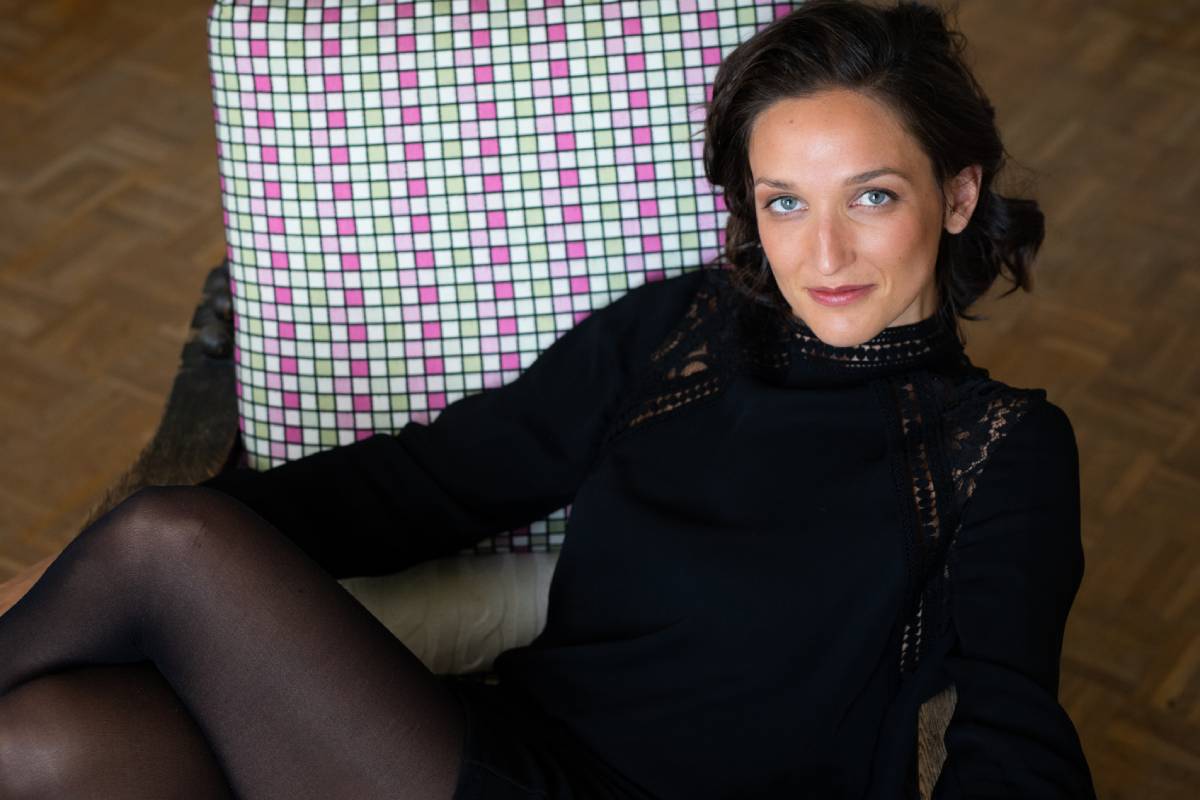
For Maria Magdalena, intimacy begins long before sex. As an actress, acting coach, and bodyworker, she has spent years exploring the space between what we say, what we feel, and what the body reveals when words fall short. Her work is rooted in a deceptively simple question: what happens when we stop trying to become better and begin allowing ourselves to become more fully ourselves?
That shift has shaped her own relationship with desire, boundaries, and connection. Once caught in the pursuit of perfection and the instinct to adapt to others, she describes discovering something quieter and more honest: the ability to recognise what she actually wants. Through the body, she learned to notice contraction, hesitation, and shame alongside openness, pleasure, and genuine desire. For her, authenticity is not an aesthetic ideal but a practice of being willing to be seen in all its imperfection.
Her understanding of intimacy also stretches well beyond romantic relationships. She sees it as a fundamental human experience, mental, emotional, physical, and deeply relational, made increasingly urgent by loneliness, digital distance, and a culture that often rewards certainty over vulnerability. Her work asks us not only to understand ourselves but also to feel, repair, and remain present when connection becomes uncomfortable.
In this conversation, Maria reflects on the body’s quiet language, the courage required to tell difficult truths, the limits of analysing our pain, and why repair deserves more attention in modern relationships. At its heart is a compelling idea: perhaps the deepest form of freedom and the place where desire becomes most alive is simply having the courage to be seen as we are.
Website
Sexiest Thing You Can Be Is Yourself
You often speak about helping people become more themselves rather than better versions of themselves. How has that shift changed your own experience of intimacy, desire, and relationships?
Maria: One of the biggest shifts, when I started becoming more of myself instead of trying to become a better version of myself, is that I could finally feel what my desires actually are. Before, I was so focused on doing things right for the other person, on having the perfect body, giving the right answers, being perfect, and being a sexy woman that I couldn’t feel myself underneath all of that. I couldn’t feel the subtleties. I couldn’t feel what I truly wanted, and I hadn’t been able to for a very long time.
I used to think I was easygoing, that I didn’t really have preferences or desires, that it was fine for me to just adapt to the needs of whoever I was with. And of course I was terrified of being seen because the nature of being human is imperfection. When you’re striving to be perfect, the last thing you want is for someone to see that you’re not. But intimacy doesn’t work if you don’t let yourself be seen.
When I finally allowed myself to be with everything I am, I began to understand what intimacy even means, what it is to be truly seen, and to be vulnerable in front of each other. Intimacy is so much more than sexuality, and we so often confuse the two. It’s a vast field, something you can create with anyone: first of all, with yourself, but also with another person, with nature, and with animals. For me, intimacy is a state of being vulnerable, showing all of myself, staying truthful to myself, and letting the other meet me there.
By allowing myself to be seen that way, and by getting in touch with my own needs and boundaries, I could finally feel my true desires. And that changed how I relate in so many ways. My relationships have become much deeper; they have more layers, more nuance, because there’s so much room for intimacy in them now.
They’ve also shifted because I’m much clearer about what I need and where my boundaries are, so I’ve become more selective about who I want to be close to and in what way, and the people I am attracting have changed through that as well.
I learned to communicate more honestly. And I learned to bring into a relationship only what feels true, not what I think the other person wants, not to please them, but what comes from a genuine desire to give. And I have learned to judge myself less and become more authentic and free through that.
That’s why, to me, the sexiest thing you can be really is yourself. Not the polished version, not the perfect one, the real one, willing to be seen. That’s where desire actually lives.

The Body Never Lies
As an actress and acting coach, you learned that the body tells the truth long before words do. What are some of the most common ways people unknowingly reveal their fears, desires, or emotional wounds through their bodies?
Maria: As an actress, I learned early that the body speaks louder than words. It’s not so much about what you say; it’s about what you feel. You can rehearse a sentence, but you can’t fake what happens in the pelvis, the breath, or the eyes. Many people think acting is about pretending, but it’s the opposite: it’s about actually living the experience. Because the body never lies.
Fear and shame usually show up as contractions. I’m speaking especially about Europe here, about the bodies I know most intimately; we hold so much stiffness, particularly in the hips. We don’t let our bodies move freely out of fear, out of shame. You can see fear whenever someone contracts: they hold back, they lean away, the body becomes smaller, and it moves backwards. Even when the mouth says yes, the body can be retreating.
Because every true “yes” is the opposite, the body opens, it comes closer, and it becomes more alive. Desire is that open body moving forward. You see it all the time when people flirt, and even more clearly when they’re trying not to flirt, but the wanting is there anyway. The body leans in and tilts towards the other. And so much of it lives in the eyes. Especially when the desire isn’t allowed, when there’s shame wrapped around it, the conditioned, societal shame that tells us we’re not supposed to want at all.
And the old wounds have their own language too. I’ve learned the most about this as a bodyworker: When you touch the skin and the muscles of a body, feel the breath, and support someone to finally look at these wounds. A collapsed chest, shoulders curled inward, a body that learned to protect the heart. A frozen pelvis in someone who was shamed for their pleasure. Breath held high and shallow in a body that never felt safe enough to let go. People don’t decide to show these things. The body simply holds the memory of everything that’s still unprocessed. My work is never to fix that. It’s to help someone feel what their body already knows and slowly let it move again.

Truth Finally Finds a Voice
In your retreats and one-to-one work, you’ve witnessed people share truths they’ve never spoken aloud before. Is there a moment or a breakthrough that profoundly changed your understanding of what intimacy really means?
Maria: Yes, I’ve witnessed so many moments where people shared truths they’d never spoken aloud before, truths they hadn’t even allowed themselves to feel.
I remember one person in a retreat who sat in silence for a long time before finally saying something they had carried, unspoken, for their whole life. The moment the words left their body, something in the whole room shifted; everyone was touched, because we all recognized ourselves in what the person was feeling. That was when I understood on a deeper level: the specific story almost doesn’t matter. What creates intimacy is the courage to be seen in it.
What I’ve learned through these moments is that intimacy can be created with anyone, in any moment, in any situation. There is no one in this world you cannot create intimacy with if you open up to your authentic truth and your vulnerability.
Then it only takes split seconds for two humans to meet in real intimacy. I’m not saying it’s easy; it takes a lot of courage. But it is very simple. If we allow ourselves to stand in front of each other, human to human, we see ourselves in the other because at our core we are all the same. That, for me, is what intimacy is: seeing myself in the other and allowing myself to be seen.

Intimacy Rule Worth Breaking
If you could challenge one widely accepted belief about sex, intimacy, or relationships, what would it be and why do you think it persists?
Maria: There are so many beliefs I’d love to challenge around these topics, but if I had to choose one, it would be the idea that intimacy is something we only experience with a romantic partner. Intimacy is so deeply misunderstood, and that misunderstanding is one of the reasons this belief persists.
The other reason is fear. If we start living intimately with more people, what does that mean? What makes a romantic relationship special if intimacy can be shared with others too? And of course jealousy shows up: Am I still special? What makes me special? Why would my partner need me if they can experience intimacy with other people?
But this all comes back to not understanding what intimacy even is. Intimacy is sharing depth, a deep connection, a deep moment, a moment of truth, and allowing ourselves to be seen. It can be mental intimacy, a truly deep conversation. It can be emotional intimacy, letting ourselves be seen in our vulnerability, in our feelings. It can be physical intimacy, starting with touch or simply with an eyegaze.

Intimacy is so far from sexuality. Sexuality can be part of it, of course, but these days there’s so much sexuality that holds no intimacy at all. They’re two entirely different things that, in the best case, show up together at the same time.
And in our society, we’re struggling so much with loneliness and individualism. Intimacy is one of the cures. It’s one of the things we have to start establishing with each other again, especially in a time of AI, of social media, of working online, and a time of so much separation and war, where everything becomes about right and wrong.
Because the moment we create intimacy, we meet each other as humans again. We start to understand that there is no separation, that we’re all the same, that we all carry the same struggles and fears and desires. We all just want to be loved; we all just want to be seen, and yet we’re all doing our best to hide, because being seen feels so scary.
I would love for people to dive deeper into intimacy to understand what it truly means and to open up to experiencing it in every kind of relationship in everyday life. We need connection as human beings. And if we don’t start being more intimate with each other, we will starve.

When Self-Awareness Goes Too Far
Some people argue that therapy culture has made relationships healthier. Others believe it’s made people hyper-analytical and quick to leave. Where do you stand?
Maria: I believe both are true at the same time. There’s so much we’ve gained through therapy and self-awareness. So much we’ve learned, and it’s beautiful that we finally allow ourselves to be helped. And yes, we’ve also reached a point where people hyper-analyze and leave a relationship before ever sitting with the pain, before figuring out how to repair what feels broken.
In my belief, this happens mainly because we still don’t want to feel. It’s one thing to analyze your pain, to understand your patterns, your relationship dynamics, your traumas, and your childhood wounds. It’s another thing entirely to actually feel them and move through them, to come out the other side. Very often, when we analyze and leave, it’s out of fear of feeling what lies underneath.
It’s a way to escape the emotion. It’s a way to escape the body. The mind is always trying to pull us out of the body, because it wants to protect us from feeling the pain.
So I don’t think therapy culture itself is the problem. It’s beautiful that we’ve started to unpack generations of trauma, but we can’t solve it with the mind alone. I’ve been in therapy for many years, and in my experience, it’s a beautiful tool that, in the end, won’t quite get you out of where you are. It might help you understand yourself better, but most of the time it won’t really change things. And when change does come, it comes very slowly. You have to actually go through it.
What I believe in is somatic work, emotional work, body work, and any modality that supports the body in releasing what’s stuck and lets the emotions finally be expressed. It’s about not stopping the moment you understand something but diving deep into the layers of pain, shame, grief, fear, anger, and guilt. Living what couldn’t be lived. Feeling what couldn’t be felt. Learning, again, how to be uncomfortable.
Because I feel we live in a time, in a society, that doesn’t want to feel discomfort. We don’t want the hardship. We want things easy and fast and comfortable. But relationships aren’t comfortable. Repairing something that broke isn’t comfortable. And we have to be willing to go through exactly that if we want to live a meaningful life.
Repair is something we’re not focusing on; nobody is really teaching us how to repair. There are so many teachings out there now, and it’s wonderful that we’re learning how to create better relationships. But there’s very little about how to repair when things get messy, when boundaries get broken, when we’re broken orart to get hurt. That, I feel, is what we’ll need to turn towards much more.
The Freedom to Be
Looking back at the woman who was constantly striving to become better, what would you tell her about pleasure, intimacy, and the freedom that comes from finally being fully yourself?
Maria: I would tell her that I completely understand she’s scared. I would tell her I have so much compassion for her. I know how terrifying it is to stop trying to become better and start accepting what is. I know how hard it is to look at all the emotions that come with that. I know it’s okay that she might feel she doesn’t have the capacity to go through it. And I know she’s afraid she’ll lose everything and everyone the moment they see she isn’t perfect.
I would tell her that her true self is so much more beautiful, so much more astonishing, than anything she could ever try to be, than any perfection. Her true, authentic self is the only version of her that can actually be loved by others, because love and truth are the same thing. She can only be truly met, truly seen, as herself. And that is what she’s really craving underneath all of it: to be seen and to be loved.
It’s only possible if she lets herself be vulnerable, imperfect, the beautiful, messy version of who she is. I would tell her it’s worth it. Every tear, every scream, every moment of pain, every moment she has to be brave, it will be so worth it that she’ll feel pleasure in ways she never believed were possible. Pleasure is out there, everywhere.
She’ll only understand what intimacy means once she allows herself to lower her guard and, through that, allows others to be imperfect too, to be vulnerable, to be seen in their unfinished selves. This is the only way to truly meet someone.
Life is only truly worth living once you’ve tasted authenticity, truth, intimacy, pleasure, and love. Once you let yourself feel everything, the good and the bad, the pain and the pleasure.
I would tell her that her life will become so much richer and so much freer, because the ultimate freedom is the freedom to be who you truly are, with everything that comes with it. Freedom means living in authenticity, making choices that come from the depth of your soul and not from your conditioning. And that is something no one can ever take away from you.

Editor Note
We spend much of our lives learning how to be acceptable to other people. We soften our opinions, hide our uncertainty, adjust our desires, and become skilled at reading what is expected of us. Sometimes the adaptation is so subtle that we mistake it for who we are.
But there is a difference between being understood and being truly known. Real closeness asks us to reveal the parts that cannot be polished: the hesitation, the contradiction, the changing mind, and the desire we are not quite sure how to name. It also asks us to listen differently, not only to what we think, but to what our bodies, boundaries, and instincts may already be telling us.
Perhaps this is why intimacy can feel both simple and frightening. It does not necessarily require grand declarations. Sometimes it is a truthful sentence, an honest no, an unguarded look, or the decision to stay present when discomfort would be easier to escape.
That connection becomes deeper not when we perfect ourselves, but when we stop performing.
